Megasession Hair Transplants can restore coverage across a large area of the scalp for appropriately selected patients with extensive hair loss. The most important questions in regard to megasessions are how much hair loss needs to be addressed? How strong is the donor supply? Where should those grafts be placed? And how can the available donor hair be used intelligently over the patient’s lifetime? These questions become increasingly important as the size of a hair transplant increases. At Golden State Hair Transplant Clinic, large procedures are planned around the individual patient and not around achieving an arbitrary graft number.
What Is a Megasession Hair Transplant?
The term megasession generally refers to a hair transplant involving approximately 3,000 or more follicular unit grafts in a single procedure. Modern follicular unit transplantation has made it possible to move considerably larger numbers of grafts than were routinely transplanted during the earlier years of hair restoration surgery. This can be particularly valuable for patients who have a substantial area of hair loss and enough permanent donor hair to support a larger procedure. However, the ability to transplant thousands of grafts does not necessarily mean that thousands of grafts should be transplanted.
A successful megasession requires careful donor assessment, thoughtful recipient-site planning, efficient graft handling, an experienced surgical team, and a long-term strategy for the possibility of future hair loss.
Who Is an Ideal Candidate for Megasession Hair Transplants?
One of the most relevant considerations is the pattern and degree of hair loss. Megasessions are generally most effective for patients with moderate to advanced pattern hair loss who need restoration across a relatively large area of the scalp. For example, a man with significant recession extending into the frontal and mid-scalp may require considerably more grafts than someone with a relatively small area of frontal recession.
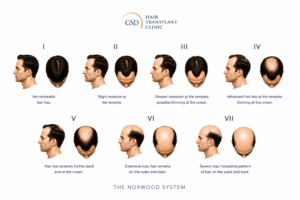
Patients with more advanced androgenetic alopecia often corresponding to the higher stages of the Norwood classification and may therefore be considered for larger sessions. But the Norwood number alone does not determine candidacy. Two men with apparently similar degrees of baldness may have very different donor reserves, hair characteristics, scalp dimensions and anticipated patterns of future hair loss. Their surgical plans may therefore be completely different.
The Pattern of Hair Loss Matters
A megasession can be particularly useful when there is a large, continuous area requiring restoration. This might include significant loss involving the frontal hairline. Frontal scalp, mid scalp and the transition area towards the crown. The surgeon must decide how to distribute the available grafts to create the greatest visual benefit. This becomes especially important in patients with advanced hair loss. Attempting to cover every square centimeter of a very large bald scalp at the same density may not be the best use of a finite donor supply. In many patients, establishing a natural hairline and creating appropriate coverage through the frontal and mid-scalp produces the greatest cosmetic impact. Crown restoration may be incorporated when donor resources permit, or it may be approached separately as part of a longer-term plan. The objective is not simply maximum coverage. It is strategic coverage.
Donor Hair Determines What Is Possible
The permanent donor area at the back and sides of the scalp represents a limited biological resource. Before considering a megasession, the surgeon must carefully evaluate factors such as: Donor density, hair calibre, characteristics of the donor area hair, stability of donor reserves and future donor reserves. A patient must have enough follicular units within the safe donor region to support the proposed procedure. For these reasons, a responsible megasession begins with careful measurement and planning not with a predetermined graft count.
Advanced Hair Loss Does Not Automatically Mean a Megasession
It is easy to assume that the more advanced the hair loss, the larger the procedure should be but that is not always true. A patient with extensive baldness but a relatively weak donor area may actually be a poor candidate for an extremely large procedure. Conversely, a patient with substantial hair loss and excellent donor density may have the resources to support a much larger transplant. There are also situations in which dividing the restoration into stages may provide greater control over donor management and long-term planning. The decision should therefore be based on the relationship between recipient demand and donor supply. That relationship is one of the fundamental principles of hair restoration surgery.
Why Megasessions Are Technically Demanding
A megasession is not simply a conventional hair transplant performed for a few additional hours. Thousands of individual follicular units must be harvested, handled, preserved, sorted and implanted while minimizing trauma to the grafts.
- At the same time, the surgeon must maintain control over hairline design, recipient-site density, direction, angle and distribution.
- As the procedure becomes larger, organization becomes increasingly important.
- The medical literature on megasessions specifically emphasizes the need for an experienced, well-organized surgical team because these procedures are technically demanding and lengthy.
- The goal is not merely to transplant a large number of grafts.
- The goal is to maintain surgical precision while working at scale.
FUE or FUT for a Megasession?
Large-session transplantation may be performed using Follicular Unit Extraction (FUE) or Follicular Unit Transplantation (FUT/strip surgery) depending upon the individual patient.
Neither technique should automatically be selected simply because a large number of grafts is required.
FUE removes follicular units individually from the donor region. FUT removes a carefully planned strip of donor scalp from which follicular units are microscopically dissected. Each technique has advantages and limitations. In patients requiring substantial numbers of grafts, the surgeon must consider donor density, scalp laxity, hairstyle preferences, previous procedures, scarring, the number of grafts required and the importance of preserving donor resources for the future. In some patients, a long-term strategy may even involve using both donor-harvesting approaches at different points during their lifetime. The technique should fit the patient and not the other way around.
Megasessions and the Long-Term Hair Restoration Plan
Perhaps the most important part of planning a large hair transplant is anticipating what the patient may look like years from now. Androgenetic alopecia is progressive. A patient may have significant hair today in areas that could become thinner in the future. The transplanted follicles may remain while the surrounding non-transplanted hair continues to miniaturize. That possibility must be considered before thousands of grafts are placed. Hairline position, density and graft distribution should therefore be designed not only for the patient’s current appearance but also for how the restoration is likely to age. A technically impressive graft count means very little if the patient’s donor supply has not been managed intelligently.
Why Experience Matters in Megasession Surgery
Large hair transplant sessions demand more from both the surgeon and the surgical team. There are thousands of individual decisions being made throughout the procedure from donor harvesting and graft preparation to recipient-site creation, hairline design, graft distribution and placement. Experience becomes particularly important when determining where not to transplant. An experienced hair restoration surgeon understands that donor hair is finite. Sometimes the appropriate decision is to concentrate grafts where they will provide the greatest visual improvement rather than attempting to cover every area of hair loss. That judgment develops over years of treating patients with different patterns of hair loss and observing how those patients’ results evolve.
Why Golden State Hair Transplant Clinic for a Megasession?
For patients considering a large hair transplant, the experience of the surgeon should be one of the most important considerations. At Golden State Hair Transplant Clinic, hair restoration surgery is led by Paul T. Rose, M.D., J.D., a board-certified dermatologist and internationally recognized hair restoration surgeon whose work in the field spans decades. Dr. Rose has been involved in hair transplantation since the earlier development of modern follicular-unit surgery and has personally contributed to the advancement of large-session-megasession hair transplantation techniques.
His career has included clinical and basic-science research in dermatology, immunology, hair disorders and hair restoration surgery. He has authored scientific publications and textbook chapters, taught hair transplantation techniques at surgical workshops around the world, and served in leadership positions within the field, including as President of the International Society of Hair Restoration Surgery. That depth of experience is particularly valuable when treating patients with advanced hair loss.
A megasession requires more than the ability to transplant thousands of grafts. It requires the judgment to determine whether a large session is appropriate in the first place, how many grafts should reasonably be used, where those grafts will provide the greatest benefit, and how much donor hair should be preserved for the future. At Golden State Hair Transplant Clinic, the goal is not to pursue the largest possible graft count. It is to create a natural, durable result while protecting the patient’s long-term options.
The Right Number of Grafts Is the Number That Fits the Patient
For the right patient, a megasession can be a powerful approach to hair restoration, allowing a substantial area of hair loss to be addressed during a single procedure. But bigger is not automatically better. The success of a large hair transplant depends upon appropriate patient selection, adequate donor resources, thoughtful design, meticulous graft handling and an experienced surgical team.
The Bottom Line
If you have moderate to advanced hair loss and are wondering whether a megasession may be appropriate, a detailed evaluation with Dr. Paul Rose can determine your donor capacity, assess your pattern of hair loss and develop a surgical plan designed around both your current needs and your future. Golden State provides you with affordable solutions and exceptional results. Talk to us today.