
Dr. Paul T. Rose’s extensive experience in natural hairline design and modern follicular-unit transplantation brings both technical knowledge and artistic judgment to this highly visible area of hair restoration. A naturally high or receding hairline can affect the proportions of the face, making the forehead appear longer or altering the balance between the upper, middle and lower facial features. A hairline-lowering transplantation offers a highly individualized way to reposition and reshape the hairline using the patient’s own hair.
Unlike surgical forehead reduction, which lowers the hairline by removing a section of forehead skin and advancing the scalp, hair transplantation creates the appearance of a lower hairline by placing individual follicular units into carefully designed recipient sites. This approach allows the surgeon to refine not only the height of the hairline, but also its shape, density, softness and relationship to the temples and surrounding facial features. The objective is not simply to create a lower hairline. It is to design a hairline that appears natural, complements the face, remains appropriate as you age.
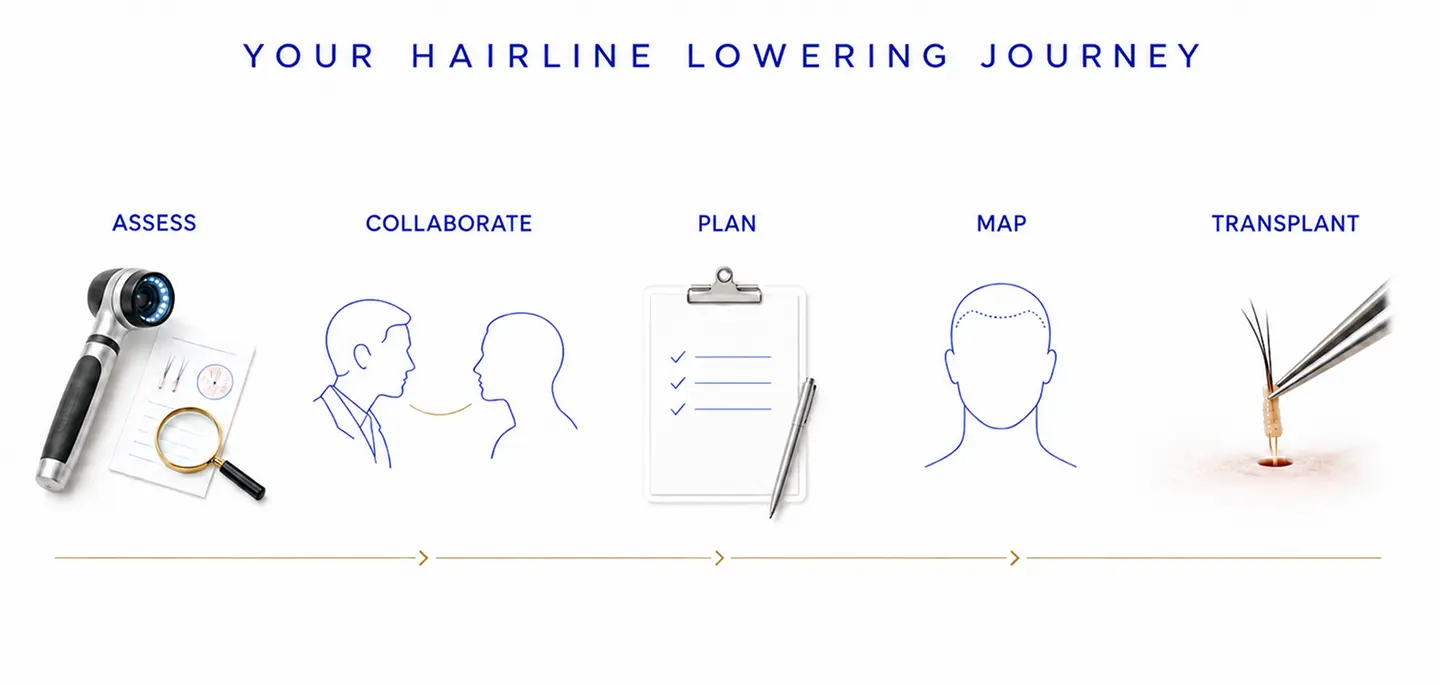
In Hairline-lowering transplantation follicles are removed from a stable donor region, generally at the back or sides of the scalp, and transplanted into the area immediately in front of the existing hairline. Building a new frontal border creates a visually reduce forehead and any recession in corners can be filled. A hairline lowering procedure modifies the overall contour of the hairline. The degree of lowering that can be accomplished depends on several factors, including one’s facial proportions, the shape and position of the existing hairline, donor hair density and quality, diameter and texture.
Hairline-lowering transplantation is an excellent procedure for women who have a naturally high hairline, an elongated forehead or localized recession around the frontal hairline and temples. Some women also exhibit what is known as a male pattern hair line where corners are recessed making the face appear much older and somewhat masculine.
Hairline design is one of the most visible and technically demanding elements of hair restoration. Even when graft growth is excellent, a hairline that has been placed too low, drawn too straight or built with inappropriate angles may appear unnatural.
An evaluation of the hairline from the front, sides and oblique views including forehead height is important but it is only one part of the design. The relationship between the central hairline, frontotemporal corners, temple points, eyebrows and underlying facial structure must also be considered. Although facial “thirds” provide a general reference when evaluating proportion, they are not a rigid formula. Natural facial anatomy varies widely. Gender, age, ethnicity, skeletal structure, hair characteristics and individual preference all influence an appropriate design. An experienced surgeon also anticipates how the hairline will appear years later. A very low hairline may require a large number of grafts to create adequate density and may consume donor hair that could be needed if additional loss occurs. This is particularly important for younger patients and for men with a family history or clinical evidence of progressive androgenetic alopecia.
A natural hairline contains subtle irregularities, changes in density and a gradual transition from finer hairs at the leading edge to greater density behind it. Single-hair follicular units are typically used along the most visible frontal border. Larger follicular units containing two or more hairs can be placed farther behind the edge to build density. Grafts must also be positioned at carefully controlled angles and directions so that the emerging hairs lie naturally and integrate with the patient’s existing growth pattern.
The distribution of grafts is as important as the number transplanted. Thoughtful design depends on restraint, variation and precise control of each recipient site. Hairline lowering is therefore both a technical and artistic procedure. Millimeters can materially change the apparent proportions of the face, making careful planning essential.
Women may seek hairline lowering because of a naturally high forehead, inherited hairline shape, temporal recession, traction-related loss or thinning following a previous cosmetic procedure. A feminine hairline is often, but not always lower and more rounded than a typical mature male hairline. The central portion may have a soft curve, with gentle transitions into the temporal areas. However, there is no single hairline shape that is appropriate for every woman. The design should reflect the individual’s face, hair texture, ethnicity, age and aesthetic preferences.
Hairline transplantation can be an important component of gender-affirming care for transgender women and men seeking a more feminine or masculine frontal hairline.
Hairline feminization may involve more than lowering the central portion of the hairline. The surgeon may also soften frontotemporal recessions, create a rounder frontal contour, rebuild temporal areas or reduce features that contribute to a more angular appearance.
Planning should be collaborative, respectful and based on the individual’s desired appearance rather than a standardized idea of femininity or masculinity.
For men, lowering or rebuilding the frontal hairline requires especially careful long-term planning. Male-pattern hair loss can continue for many years, even after a successful transplant. The transplanted follicles may remain, while the nontransplanted hair behind them continues to thin. The surgeon must evaluate the current pattern of loss, degree of follicular miniaturization, family history, donor reserves and likely future progression. Medical therapy may be discussed when appropriate to help preserve existing hair.
With follicular unit excision, or FUE, individual follicular units are removed using small circular punches. The procedure does not create a linear donor scar, although it does leave numerous small circular scars that are usually less noticeable when the donor area is harvested appropriately.
FUE may be advantageous for patients who prefer shorter hairstyles or want to avoid a linear incision. However, extensive or poorly distributed extraction can visibly thin the donor area. FUE should never be described as scarless, and the number of follicles removed must remain within the safe limits of the patient’s donor supply.
With follicular unit transplantation, or FUT, a narrow strip of hair-bearing scalp is removed from the donor region. The incision is closed, leaving a linear scar that is generally concealed by the surrounding hair. The strip is then microscopically dissected into individual follicular units.
FUT can provide a substantial number of high-quality grafts while preserving follicles throughout the remaining donor area. It may be particularly useful when a patient requires a larger number of grafts or wishes to avoid widespread shaving.
The choice between FUE and FUT is not simply a matter of which technique is newer. Each has advantages, limitations and implications for long-term donor management. The decision should be based on the patient’s anatomy, hairstyle, previous surgery, donor characteristics and anticipated lifetime needs.
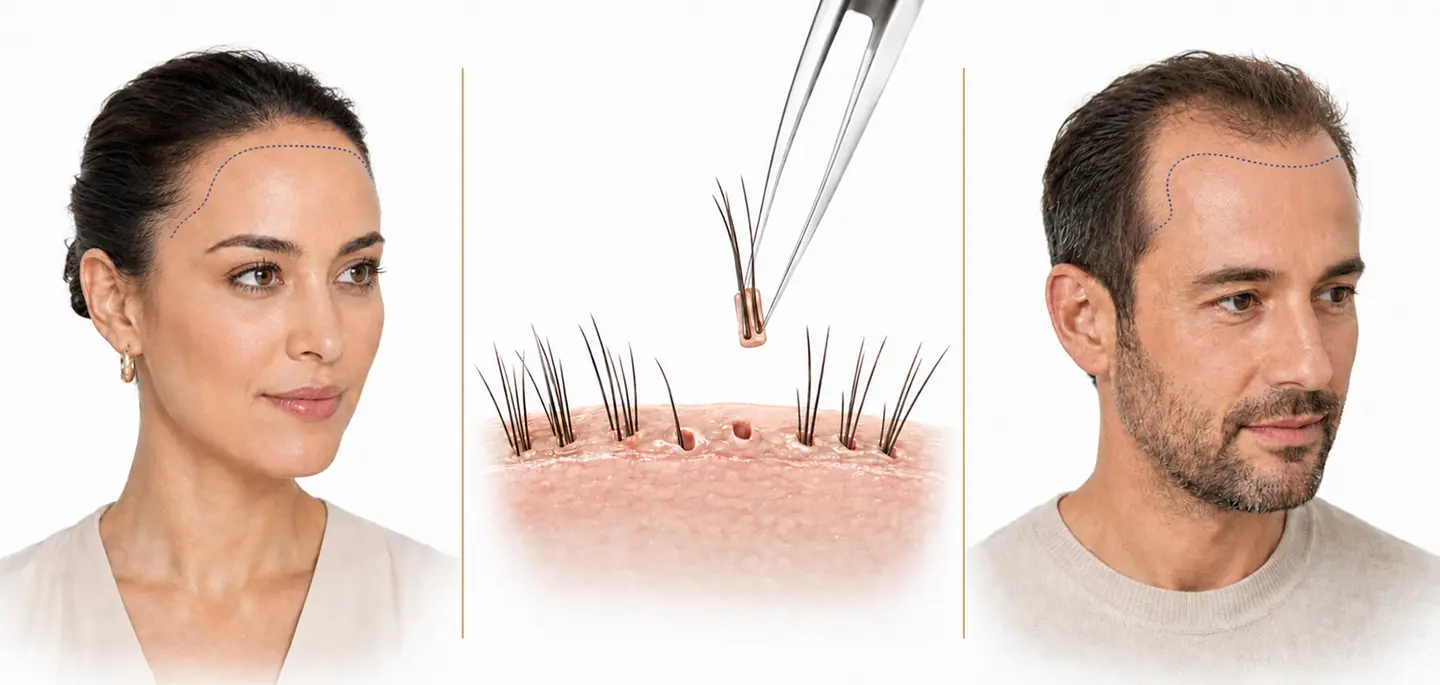
Before surgery, the proposed hairline is drawn and evaluated with the patient while they are seated upright. This allows the patient and surgeon to assess the design from multiple perspectives and discuss any final adjustments.
On the day of surgery, the donor and recipient areas are prepared, local anesthesia is administered and the patient made comfortable. Patients often read, listen to music and many often take naps during the procedure. Follicular units are harvested using the selected FUE or FUT technique. The grafts are then examined and sorted according to the number of hairs they contain.
Recipient sites that determine the position, angle, direction and distribution of the transplanted follicles are created by Dr Rose. The grafts are placed into these sites with particular attention to protecting them from unnecessary trauma and maintaining the intended pattern.
Procedure length varies according to the harvesting method, number of grafts and complexity of the design. Every patient receives individualized postoperative instructions on how to protect the grafts and care for your hair and what to expect during recovery.
Hairline lowering places the surgeon’s work in one of the most visible areas of the scalp. Small differences in position, angulation and graft selection can have a significant effect on the final appearance.
Dr. Paul T. Rose is an internationally recognized hair restoration surgeon whose work has contributed to the advancement of follicular-unit transplantation, natural hairline design and modern donor-harvesting techniques. His approach considers the immediate aesthetic objective within a broader lifetime plan, including donor preservation, the possibility of future hair loss and the need for the result to remain natural as the patient ages.
At Golden State Hair Transplant, hairline design begins with diagnosis, careful examination and a detailed understanding of the patient’s goals. The purpose of the consultation is not simply to determine how far the hairline can be lowered, but whether transplantation is appropriate and what design can be supported safely and naturally over time.
The amount of lowering varies considerably. It depends on the width of the area being treated, the density desired, the available donor supply and the number of grafts that can be harvested responsibly. A modest adjustment can sometimes make a significant difference in facial proportion.