What Is a Body Hair Transplant?
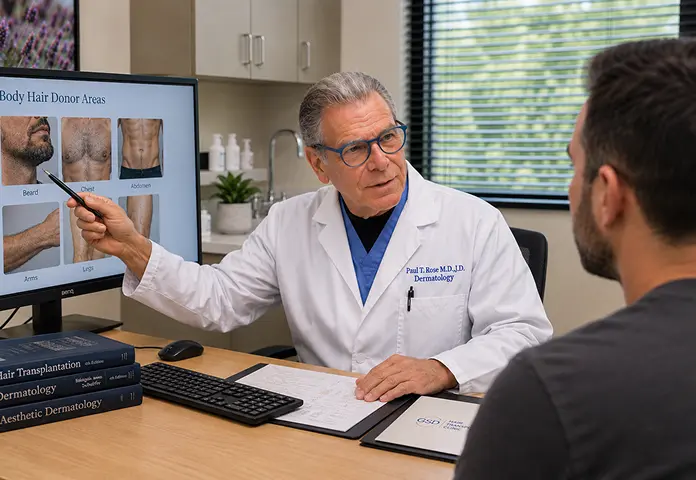
Body hair transplantation involves harvesting individual follicular units from an area outside the traditional scalp donor region and transplanting them into another area, most commonly the scalp. Potential donor areas may include the beard or area beneath the chin, the chest, the abdomen or back and the arms or legs. Not every area is suitable for every patient. Beard hair is often the most useful non scalp donor source because it is typically thicker and may provide greater visual coverage than finer body hair. The suitability of chest or other body hair depends on its density, texture, color, growth length and the purpose for which it is used in transplantation.
When May Body Hair Be Considered?
Body hair transplantation may be considered for patients who have limited remaining scalp donor hair, have undergone one or more previous hair transplants, require additional coverage for corrective or restorative procedure, have scarring or overharvesting within the scalp donor area and need additional coverage in selected areas of the scalp or possess body or beard hair with suitable characteristics. Body hair may also be blended with scalp hair to supplement coverage in strategic areas. It is generally used as a secondary donor resource rather than a direct replacement for high-quality scalp donor hair.
How Body Hair Differs From Scalp Hair
Hair from different areas of the body retains many of its original characteristics after transplantation. Beard, chest, and scalp hairs may differ in areas such as thickness and texture, color. curl or wave, growth cycle duration, and the numbers of hair within each follicular unit. For example, beard hair is often coarser than scalp hair and usually grows in predominantly single-hair follicular units. Chest and other body hairs may be finer, grow for shorter periods, and provide less predictable length or coverage. These differences influence where each type of hair can be used most effectively. Coarser beard grafts may help increase the appearance of density in central areas, while finer body hair may occasionally be used to soften transitions or supplement coverage. Careful placement and blending are essential to avoid a visible mismatch.
The Body Hair Transplant Procedure
Body hair follicles are generally harvested individually using follicular unit extraction, or FUE. Because follicle depth, angle, and growth direction vary considerably across the body, harvesting requires a technique adapted to the specific donor area.
Before the procedure, the surgeon evaluates the available scalp, beard, and body hair to determine which follicles are most suitable. The donor area may be trimmed so that the direction and distribution of the hairs can be examined. Individual grafts are then extracted and carefully inspected before transplantation. Recipient sites are created in the treatment area according to the planned direction, angle, and distribution. The grafts may be used alone in a selected region or combined with scalp follicles to produce a more cohesive result. The procedure is performed using local anesthesia. The length of treatment depends on the donor areas involved and the number of usable grafts that can be safely obtained.
Strategic Use of Body Hair
Body hair must be used thoughtfully. It may be valuable for adding coverage through the midscalp or crown, reinforcing selected areas, or supporting the repair of a previous transplant. Because beard hair is often noticeably coarser, it is generally better suited to areas where additional visual density is needed than to the delicate front edge of the hairline. When suitable scalp hair is available, finer scalp grafts are typically preferred for creating a soft, natural-looking frontal hairline. Beard or body hair can then be blended behind this area to support the overall appearance of coverage. The objective is not simply to obtain the greatest possible number of grafts. It is to use each available donor resource where its particular characteristics will provide the greatest aesthetic benefit.
Recovery and Growth
Small crusts and temporary redness may develop in both the donor and recipient areas. Healing varies according to the location from which the follicles were harvested. Patients receive specific instructions for cleansing and protecting each treated area. The transplanted hairs commonly shed during the first several weeks. New growth then begins gradually over the following months. Because body hair has a different natural growth cycle from scalp hair, its growth rate, length, and maturation may vary. Results should be evaluated over time. More than one procedure may sometimes be considered, depending on the patient’s donor resources, treatment goals, and response to the initial transplant.
Is Body Hair Transplantation Right for You?
Body hair transplantation is a specialized procedure and is not appropriate for everyone. The presence of body hair alone does not necessarily mean that it will provide useful transplant grafts. Hair caliber, density, growth pattern, follicle structure, skin characteristics, and the condition of the proposed donor area must all be evaluated. It is also important to understand that body hair does not restore a depleted scalp donor supply or behave exactly like native scalp hair. Its greatest value is often as a carefully selected supplementary resource within a broader, long-term restoration plan.
During your consultation, Dr Rose will evaluate your scalp donor reserves and the characteristics of any potential beard or body donor hair. If body hair transplantation is appropriate, the procedure will be planned to use these limited grafts strategically and create the most natural, balanced result possible.