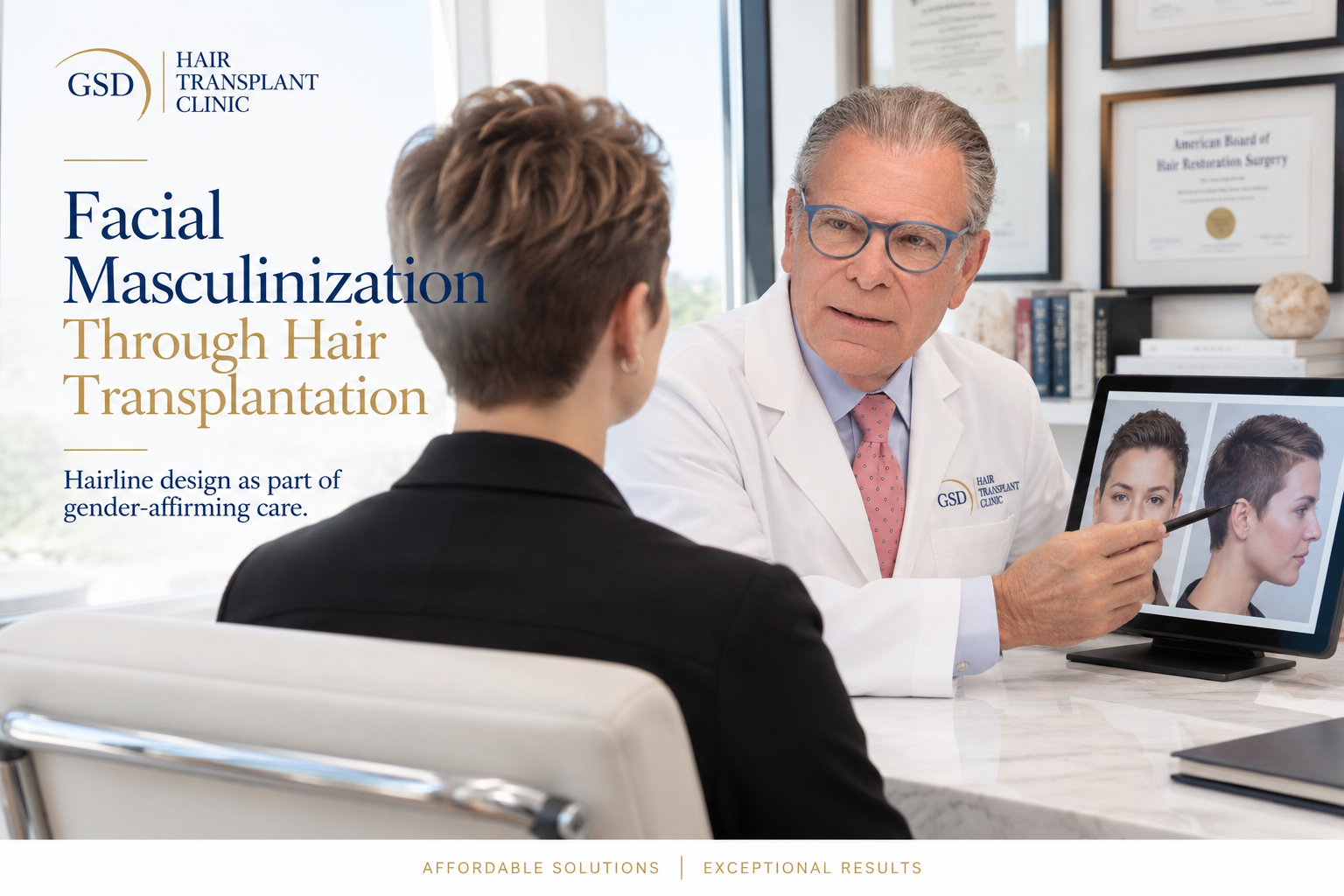
Facial masculinization hair transplants go a long way in helping affirm identity. When people think about facial masculinization, they often focus on changes to the jawline, chin, or facial contours. Yet one of the most influential and frequently overlooked elements of a masculine appearance is the distribution and design of hair across the face and scalp. The hairline, temple points, eyebrows, sideburns, beard, and mustache all work together to frame the face and strongly influence how we are perceived. For transgender men and individuals seeking a more masculine appearance, hair transplantation has become an increasingly valuable component of gender-affirming care.
Modern hair restoration techniques allow experienced surgeons to do far more than simply restore hair. They can reshape the hairline, reconstruct temple points, enhance eyebrow density, create natural sideburns, and design facial hair that complements each patient’s unique facial anatomy and aesthetic goals.
Unlike traditional hair transplantation, which primarily addresses hair loss, facial masculinization through hair transplantation is centered on facial design. Every graft is placed with a specific purpose to enhance facial harmony, strengthen masculine characteristics, and create results that appear entirely natural. Rather than focusing on a single feature, the procedure considers how each component works together to create a balanced masculine facial frame.
Because every individual’s transition is unique, there is no single approach that is appropriate for every patient. Some may benefit from subtle refinement of the hairline alone, while others may choose to combine hairline masculinization with beard, eyebrow, or sideburn transplantation as part of a more comprehensive treatment plan. The goal is never to create a standardized appearance, but rather to achieve natural-looking results that reflect the individual’s identity, anatomy, and long-term goals.
As gender-affirming healthcare continues to evolve, hair transplantation has become an important option for patients seeking lasting improvements in facial appearance. When combined with thoughtful planning, artistic design, and meticulous surgical technique, it can play a meaningful role in helping individuals achieve facial features that feel authentic, balanced, and uniquely their own.
Facial Masculinization Hair Transplants and the Importance of Facial Framing
Masculinity is rarely defined by a single facial feature. Instead, it is the relationship between multiple facial characteristics that creates the overall impression of a masculine face. Bone structure, skin texture, facial proportions, and the distribution of hair all contribute to this perception, with hair serving as one of the most recognizable visual cues. The concept of facial framing refers to the way hair outlines and enhances the face.
A masculine facial frame is created not only by the hairline, but also by the temple points, eyebrows, sideburns, beard, and mustache. Together, these features establish the borders of the face, influence facial proportions, and draw attention to the eyes, cheeks, and jawline. Unlike many cosmetic procedures that focus on changing a single feature, facial masculinization through hair transplantation considers how these individual elements interact. Enhancing one area while overlooking another may leave the face feeling incomplete or unbalanced. Conversely, carefully planned improvements across several facial regions can create subtle yet significant changes that strengthen masculine characteristics while maintaining a natural appearance.
This comprehensive approach is highly individualized. Some patients may achieve their goals through hairline masculinization alone, while others may benefit from reconstructing the temple points, increasing eyebrow density, restoring facial hair, or a combination of these. Treatment recommendations should always be guided by the patient’s anatomy, transition goals, existing hair characteristics, and personal preferences. Successful facial masculinization is not about creating the most dramatic transformation possible. Rather, it is about developing a cohesive masculine facial frame that appears authentic, proportionate, and consistent with the individual’s identity.
“The masculine hair frame is created by the relationship between the hairline, temple points, eyebrows, sideburns, beard, and mustache. While each feature contributes individually, it is their balance and proportion that ultimately influence masculine facial appearance.”
The Masculine Hair Frame
The face is recognized as a whole rather than as a collection of individual features. While the eyes, nose, jawline, and cheekbones all contribute to facial appearance, the distribution of hair across the face and scalp plays an equally important role in how masculine facial characteristics are perceived. Rather than focusing on a single area, successful facial masculinization considers what can be described as the masculine hair frame, the relationship between the hairline, temple points, eyebrows, sideburns, beard, and mustache. Together, these structures outline the face, define facial proportions, and contribute to an appearance that is both natural and harmonious.
Each of these features performs a distinct role. A masculine hairline typically creates a broader upper face with more defined frontotemporal angles. Temple points connect the scalp to the sideburns, completing the lateral frame of the face. Eyebrows influence facial expression and often appear fuller and flatter than those typically associated with feminine facial features. Sideburns establish continuity between the scalp and beard, while facial hair enhances jawline definition and creates additional visual structure.
Although each area can be treated individually, the greatest aesthetic improvements are often achieved when they are planned together. For example, reconstructing a masculine hairline without considering the temple points may leave the upper face appearing incomplete. Likewise, restoring a beard without appropriate sideburn design may interrupt the natural transition between the scalp and facial hair.
This comprehensive approach recognizes that facial masculinization is not defined by any one procedure. Instead, it is achieved by thoughtfully balancing multiple elements to create a facial appearance that reflects the individual’s identity while respecting their unique anatomy. The objective is never to create an exaggerated or artificial result, but rather to establish a masculine facial frame that appears entirely natural.
Why This Approach Is Different
Facial masculinization through hair restoration is fundamentally different from conventional hair transplantation performed to treat hair loss. While traditional procedures are designed to replace missing hair, gender-affirming hair restoration focuses on reshaping and enhancing facial characteristics.
Every treatment plan begins with understanding the patient’s goals. Some individuals may seek only subtle refinement of the hairline, while others wish to develop fuller eyebrows, more defined sideburns, or a beard that testosterone alone has not produced.
Many patients benefit from a combination of procedures performed either during a single treatment session or as part of a staged treatment plan. The surgeon’s role extends beyond transplanting hair follicles. It involves evaluating facial proportions, anticipating how each feature will interact with the others, and designing a long-term strategy that produces balanced, natural-looking results. This individualized approach ensures that every procedure contributes to a cohesive masculine appearance rather than treating each feature in isolation.
Ultimately, successful facial masculinization is measured not by how many grafts are transplanted, but by how naturally the restored hair integrates with the patient’s existing features. The most effective results are those that enhance facial harmony while allowing the individual to feel more confident, authentic, and comfortable in their appearance.
The Role of Hormone Therapy in Facial Masculinization
For many transgender men, testosterone therapy is one of the most important components of gender-affirming care. Beyond changes in voice, muscle mass, fat distribution, and skin texture, testosterone also influences hair growth throughout the body and face, often playing a significant role in the development of a more masculine appearance. As hormone therapy progresses, many individuals notice increased facial hair growth, including the beard, mustache, and sideburns, along with changes in body hair and scalp hair characteristics.
The extent of these changes, however, varies considerably from person to person. Genetics, age, ethnicity, and the duration of hormone therapy all influence how an individual responds. Some patients develop a full beard and naturally masculine hairline, while others experience only modest facial hair growth or areas that remain patchy despite years of hormone therapy. Likewise, testosterone cannot predictably create stronger temple points, reshape eyebrow contours, or establish the specific hairline architecture that many individuals desire as part of their transition.
Hair transplantation offers a way to enhance and refine these features when hormone therapy alone has not produced the desired result. Rather than replacing the effects of testosterone, hair restoration builds upon them by allowing the surgeon to strategically design a masculine facial frame that complements the patient’s anatomy and aesthetic goals. Because every patient responds differently to hormone therapy, treatment plans should always be individualized.
Ultimately, hormone therapy and hair transplantation should be viewed as complementary components of gender-affirming care. Testosterone provides the biological foundation for masculinization, while hair restoration offers the precision to refine facial features and create a cohesive masculine appearance that reflects each patient’s individual goals.
Hairline Masculinization: The Foundation of a Masculine Facial Frame
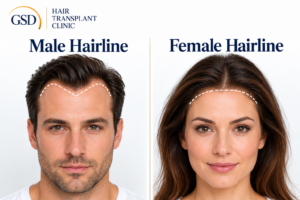
The hairline is one of the most influential features in facial gender perception. Before a person notices individual characteristics such as the eyes, nose, or jawline, the hairline helps establish the overall frame of the face. Its shape, height, and relationship to surrounding facial features all contribute to whether the face is perceived as more masculine or more feminine.
For those seeking a more masculine appearance, hairline masculinization is often one of the most transformative aspects of gender-affirming hair restoration. Rather than simply adding hair, the procedure focuses on strategically designing a hairline that complements masculine facial proportions while maintaining a natural appearance. Unlike feminine hairlines, which generally feature softer curves and minimal temple recession, masculine hairlines tend to have greater definition at the frontotemporal angles. This creates a broader, more squared appearance that frames the forehead and contributes to stronger facial contours. The objective is not to exaggerate these characteristics, but to recreate the subtle features commonly seen in naturally masculine hairlines.
One of the most common misconceptions is that creating a masculine appearance simply involves lowering the hairline. In reality, the opposite is often true. An experienced hair restoration surgeon carefully evaluates forehead height, facial proportions, brow position, existing hair density, and long-term hair stability before determining the most appropriate hairline design. In many cases, preserving or even creating subtle temporal recession produces a more authentic masculine appearance than placing the hairline lower across the forehead.
Naturalness remains the guiding principle throughout the design process. A masculine hairline should never appear as a straight, sharply defined border. Instead, it should incorporate subtle irregularities, natural transitions, and varying hair densities that replicate the way hair naturally grows. Individual follicular units are carefully placed to create a soft leading edge while maintaining the stronger contours that characterize a masculine facial frame.
Hairline masculinization is not about creating the same appearance for every patient. Facial structure, ethnicity, age, hair characteristics, and personal goals all influence the final design. Some individuals may prefer a youthful hairline with subtle masculine characteristics, while others seek a more mature appearance with greater definition at the temples. The most successful results are those that appear entirely natural and are thoughtfully tailored to the individual rather than following a predetermined template.
Hairline masculinization becomes the foundation upon which the remaining elements of the masculine facial frame can be built. It establishes the upper border of the face and provides the framework that allows the eyebrows, temple points, sideburns, and facial hair to work together in creating balanced, masculine facial harmony.
Temple Point Reconstruction: The Often-Overlooked Key to a Masculine Facial Frame
While much of the attention surrounding hairline masculinization focuses on the frontal hairline, one of the most defining features of a masculine facial frame is often overlooked are the temple points. Temple points are the small triangular areas of hair located just in front of the ears, where the frontal hairline transitions into the sideburns. Although subtle, they serve as an important connection between the scalp and the face. Their shape and position help define the width of the upper face, strengthen facial contours, and contribute to the overall perception of masculine facial structure. In many transgender men, the temple points remain relatively fine or underdeveloped despite hormone therapy.
As a result, even when the frontal hairline has been successfully masculinized, the absence of well-defined temple points can leave the upper face appearing incomplete. This interruption in the natural transition between the hairline and sideburns is often difficult to identify, yet it can significantly influence overall facial balance.
Reconstructing the temple points requires exceptional surgical precision. Unlike many areas of the scalp, hair in this region grows at an extremely acute angle against the skin and follows a highly specific direction. Every follicular unit must be placed with meticulous attention to angle, orientation, and density to recreate the natural flow of hair. Even small deviations can become noticeable because of the highly visible location of the temple points.
Reconstructed temple points create a smooth transition from the hairline into the sideburns, completing the lateral frame of the face. They can make the forehead appear more proportionate, enhance the definition of the upper face, and strengthen the overall masculine appearance without drawing attention to the procedure itself.
Like every aspect of facial masculinization, temple point reconstruction should be individualized. The size, density, and position of the temple points should complement the patient’s facial proportions, ethnicity, hairstyle, and long-term aesthetic goals. The objective is never to create exaggerated features, but to restore a natural balance that appears authentic from every angle. Although temple points represent a relatively small area, their contribution to facial harmony is substantial. For many patients, they are the finishing detail that transforms a well-executed hairline into a cohesive masculine facial frame.
Eyebrow Design: An Essential Element of Facial Masculinization
The eyebrows are among the most expressive features of the human face. They influence how emotions are perceived, help define the upper face, and play a significant role in facial gender recognition. While patients often focus on the hairline or beard during gender transition, the eyebrows can have an equally meaningful impact on creating a more masculine appearance.
Masculine eyebrows typically differ from feminine eyebrows in several subtle but important ways. They are often fuller, flatter, and positioned slightly lower along the brow ridge, creating a stronger, more defined appearance. In contrast, feminine eyebrows tend to have a higher arch and a more curved contour. Although these differences may seem minor, they contribute significantly to the way the face is perceived as a whole.
Testosterone therapy may increase eyebrow density in some individuals, but these changes are often modest and highly variable. Many patients continue to have naturally sparse eyebrows, areas of uneven growth, or eyebrow shapes that do not fully align with their facial masculinization goals. Hair transplantation can be used to increase eyebrow density, restore areas of thinning, or subtly modify eyebrow shape while preserving a natural appearance. Because eyebrow hairs grow in highly specific directions, each follicular unit must be meticulously placed to replicate the intricate growth patterns found in a natural eyebrow. Precision is essential, as even slight variations in angle or direction can affect the final result.
When thoughtfully planned, fuller and more structured eyebrows can enhance facial expression, strengthen the appearance of the eyes, and contribute to greater overall facial harmony.
In many cases, eyebrow restoration is performed alongside hairline masculinization or beard transplantation as part of a comprehensive treatment plan. Addressing these features together allows the surgeon to create a cohesive masculine appearance in which each element complements the others rather than standing alone. Although the eyebrows occupy a relatively small area of the face, their influence on facial character is remarkable. For many patients, restoring eyebrow density provides the detail that helps unify the upper face and complete the process of facial masculinization.
Completing the Masculine Facial Frame
Successful facial masculinization is rarely achieved by modifying a single feature in isolation. Instead, the face should be viewed as a collection of interconnected elements that work together to create balance, proportion, and masculine facial characteristics.
The upper facial frame consists of the hairline, temple points, and eyebrows. Together, these structures define the forehead, frame the eyes, and establish the overall architecture of the upper face. When carefully designed, they create stronger facial contours while maintaining a natural appearance.
The lower facial frame is formed by the sideburns, beard, and mustache. These features influence the perceived width of the face, strengthen jawline definition, and contribute to the facial characteristics traditionally associated with masculinity. The transition between the sideburns and beard is particularly important, as it creates continuity between the scalp and lower face.
Although each of these features can be enhanced individually, the most natural and aesthetically pleasing results are achieved when they are planned together. A masculine hairline may appear incomplete without appropriately designed temple points. Likewise, a well-developed beard can look disconnected if the sideburns do not provide a natural transition from the scalp. Even subtle refinements to the eyebrows can influence how the entire face is perceived.
This comprehensive approach recognizes that facial masculinization is not about creating exaggerated features. Instead, it is about establishing harmony between each component of the masculine facial frame so the overall appearance feels balanced, authentic, and uniquely suited to the individual.
Every patient has different goals. Some may seek only hairline masculinization, while others may benefit from a combination of procedures that include temple point reconstruction, eyebrow restoration, beard transplantation, or sideburn enhancement. The treatment plan should always be individualized, reflecting the patient’s anatomy, transition goals, and personal preferences rather than a one-size-fits-all approach.
Sideburn Restoration: Creating a Natural Transition
Sideburns play a vital role in defining the shape and continuity of the face. Positioned between the scalp and the beard, the sideburns create a visual bridge that helps establish a cohesive masculine appearance. For many transgender men, testosterone therapy stimulates increased facial hair growth over time. However, the development of the sideburns can be highly variable. Some individuals achieve excellent density, while others experience sparse growth, uneven distribution, or sideburns that fail to connect naturally with the beard.
Hair transplantation can be used to restore or enhance the sideburns, creating a fuller and more balanced transition between the scalp and lower face. As with every aspect of facial hair restoration, careful attention must be paid to hair direction, density, and natural growth patterns. Sideburn hairs grow at shallow angles and follow distinct directional changes, requiring meticulous placement of each follicular unit. Although sideburn restoration is a relatively small procedure, it often has a disproportionately large impact on facial harmony. By completing the transition between the hairline and beard, well-designed sideburns help unify the masculine facial frame and contribute to a more natural overall appearance.
Beard and Mustache Restoration: Defining the Lower Face
For many transgender men, the beard and mustache are among the most meaningful aspects of facial masculinization. They not only influence appearance but also play an important role in gender expression, self-confidence, and identity. While testosterone therapy often stimulates facial hair growth, the degree of development varies widely, and some individuals may continue to experience patchy or incomplete facial hair despite years of hormone therapy.
Hair transplantation offers a permanent solution for enhancing facial hair density and creating beard and mustache patterns that complement the patient’s facial structure. The beard can be designed to strengthen the appearance of the jaw, improve facial symmetry, and create balance between the upper and lower face. Likewise, mustache transplantation can increase density or refine shape, helping create facial hair that appears consistent with naturally developed masculine features.
Every beard is unique. Differences in hair texture, curl pattern, density, and facial anatomy require an individualized treatment plan tailored to the patient’s goals. Whether the objective is a subtle enhancement or a full beard reconstruction, successful outcomes depend on careful planning and meticulous graft placement. When combined with hairline masculinization, temple point reconstruction, eyebrow restoration, and sideburn enhancement, beard and mustache transplantation complete the masculine facial frame. Together, these procedures create facial harmony while allowing each feature to complement the others in a natural and balanced way.
In Conclusion
No two patients share the same facial structure or aspirations, which is why successful facial masculinization is never based on a standardized approach. Whether treatment involves subtle refinement of the hairline, reconstruction of the temple points, enhancement of the eyebrows, or restoration of the beard and sideburns, every procedure should be carefully planned to create results that are balanced, natural-looking, and uniquely suited to the individual.
As gender-affirming healthcare continues to evolve, hair restoration has become an increasingly important component of comprehensive facial masculinization. When approached with careful planning, surgical precision, and an appreciation for facial harmony, hair transplantation can provide permanent, natural-looking improvements that not only enhance masculine facial characteristics but also help individuals feel more confident, authentic, and comfortable in their own appearance.
The best gender-affirming hair restoration is virtually undetectable. Your transplant entails meticulous planning with an artistic eye; the transplanted hair should simply look like it has always belonged there allowing your appearance to reflect your identity, naturally and confidently.
Choosing a surgeon for gender-affirming hair restoration is one of the most important decisions you will make during your transition or affirmation journey. While surgical skill is essential, the ideal surgeon should also understand the unique anatomical, aesthetic, and emotional aspects of gender affirmation. Unlike traditional hair restoration, gender-affirming procedures require careful planning that extends beyond simply restoring hair. Every decision from hairline position and shape to eyebrow design, beard density, temple points, sideburns, and facial framing should be tailored to create features that are harmonious with your gender identity, facial proportions, and long-term goals.
Credentials and Experience Matter. Hair transplantation is a highly specialized surgical procedure. Excellent results require not only artistic judgment but also meticulous surgical technique, proper graft handling, and a highly experienced medical team.
Perhaps the most overlooked quality when choosing a hair transplant surgeon is communication. Gender-affirming care should always begin with listening. Dr Rose takes the time to understand your goals, answer your questions without judgment, explain both the benefits and limitations of treatment, and ensure you feel informed and comfortable throughout the entire process. He believes the best surgical outcomes are achieved when there is a strong partnership between patient and surgeon, built on trust, realistic expectations, and a shared vision of success.
No two patients have the same facial structure, hair characteristics, donor supply, or transition goals. A personalized treatment plan should always take precedence over standardized designs or trends.
Read more: Does a hair transplant hurt?