

Why Am I Losing My Hair?
The Science Behind Hair Loss
Hair loss. Whether it begins as increased shedding in the shower, a widening part, a gradually receding hairline, or a noticeable decrease in hair density, the experience often raises questions about why this is happening, The answer is rarely as simple as “getting older” or “it’s genetic.” Hair growth is a remarkably biological process influenced by genetics, hormones, immune function, nutrition, aging, and overall health. When one or more of these factors changes, the normal cycle of hair growth can be disrupted, leading to thinning, excessive shedding, or permanent hair loss.
Fortunately, our understanding of hair biology has advanced dramatically over the past two decades. We now know far more about how hair follicle’s function, why different forms of hair loss occur, and how targeted medical and surgical treatments can slow progression, preserve existing hair, and, in many cases, restore the hair that has been lost.
In this article, we’ll explore how healthy hair grows, what happens when that process is disrupted, why every type of hair loss behaves differently, and how modern hair restoration has evolved into a comprehensive field that combines dermatology, medical therapy, and advanced surgical techniques to help patients achieve natural, long-lasting permanent results.
The Follicle
The Hair Growth Cycle
One of the most common misconceptions about hair is that it grows continuously throughout life. In reality, every hair follicle follows a highly regulated biological cycle consisting of distinct phases of growth, transition, rest, and shedding. Rather than functioning independently, each follicle cycles according to its own internal clock, allowing the scalp to maintain a relatively consistent appearance despite the continuous turnover of individual hairs.
Because follicles are at different stages of this cycle at any given time, healthy hair is constantly growing, resting, and shedding. This is why losing some hair every day is not only normal but an essential part of maintaining healthy hair density. In fact, most people shed between 50 and 100 hairs each day, with new hairs simultaneously beginning to grow from those same follicles.
Problems arise when this carefully balanced cycle becomes disrupted. Hair may spend less time growing, remain in its resting phase longer than normal, or fail to produce a healthy replacement hair altogether. Hair doesn’t grow continuously. It moves through the four distinct phases, each playing a different role in keeping your hair healthy and full.
Anagen: The Growth Phase
Catagen: A Short Pause in Growth
Telogen: The Resting Phase
Exogen Phase: The Shedding Phase
When the Hair Growth Cycle Becomes Disrupted
Although the hair growth cycle is remarkably efficient, it is also highly sensitive to changes within the body. Genetic factors, hormonal influences, nutritional deficiencies, illness, certain medications, autoimmune diseases, inflammation, and significant physical or emotional stress can all alter the timing and regulation of the hair cycle. Depending on the underlying cause, follicles may enter the resting phase prematurely, produce progressively finer hairs through a process known as miniaturization, or stop producing visible hairs altogether.
These biological changes often begin months before thinning becomes noticeable, which is one of the reasons hair loss can appear to develop gradually. Understanding how and why the growth cycle changes is essential because different conditions disrupt the cycle in different ways and those differences determine which treatments are most likely to be effective.
Did You Know?
- The average scalp contains approximately 100,000 hair follicles.
- Hair grows at an average rate of about ½ inch (1.25 cm) per month, although this varies among individuals.
- Everyone is born with nearly all the hair follicles you will ever have.
- Hair restoration treatments work by preserving, reactivating, or redistributing your existing follicles.
Why Hair Loss Happens
Although hair loss may seem sudden, the biological changes responsible for thinning hair usually begin long before they become visible. In many cases, the hair follicle continues to function, but it no longer functions as efficiently as it once did. Rather than producing thick, healthy terminal hairs, it gradually begins producing hairs that are shorter, finer, and less visible. This change does not occur because the follicle simply “stops working.” Instead, it reflects a complex series of biological events that alter the normal balance of cell signaling, hormone activity, immune function, and tissue regeneration within and around the follicle. Healthy hair growth depends on continuous communication between the dermal papilla, stem cells, blood vessels, immune cells, surrounding connective tissue, and numerous signaling pathways. These systems work together to regulate the hair growth cycle, determine how long a hair remains in its active growth phase, and influence the size, thickness, and pigmentation of each new hair shaft. When this communication is disrupted, the cycle begins to change.
In some individuals, genetic sensitivity to hormones gradually alters follicular activity. In others, inflammation, autoimmune disease, nutritional deficiencies, medications, systemic illness, or significant physiological stress interfere with the follicle’s ability to maintain normal growth. One of the earliest changes is often a shortening of the anagen, or growth, phase. As hairs spend less time actively growing, they have less opportunity to reach their previous length and thickness before entering the resting phase. Over time, the follicle may also become progressively smaller. This process known as follicular miniaturization.
Follicular Miniaturization: A Hallmark of Pattern Hair Loss
Rather than disappearing suddenly, affected follicles gradually decrease in size over many years. With each new growth cycle, the follicle produces a hair shaft that is slightly finer, shorter, and less pigmented than the one before it. As this process continues, thick terminal hairs are slowly replaced by fine, wispy hairs that provide progressively less coverage of the scalp. Importantly, the follicle itself often remains alive throughout much of this process. This is why early intervention can be so important. Treatments that slow or interrupt miniaturization may help preserve existing hair before irreversible damage occurs. Miniaturization does not affect every follicle equally. In pattern hair loss, follicles along the frontal hairline, temples, and crown are typically more susceptible, while follicles along the back and sides of the scalp are generally more resistant. This difference in genetic sensitivity forms the basis of modern hair transplantation, where resistant donor follicles are relocated to areas affected by thinning.
The Follicular Environment
Follicular miniaturization is one of the defining characteristics of androgenetic alopecia, the most common cause of hair loss in both men and women.
Hair Loss Is Often Progressive
One of the tricky things about hair loss is that what you see often lags behind what’s actually happening beneath the surface. You might notice your scalp becoming more visible, or your part looking wider, over the course of a few months. But the changes causing that usually started years earlier. Since each hair follicle works on its own timeline, small changes build up gradually often long before they become noticeable. That’s exactly why catching hair loss early matters so much. The sooner it’s identified, the better the chances of preserving the hair you have and slowing or even stopping further loss. So if you’re noticing thinning or more shedding than usual, don’t just chalk it up to “getting older.” It’s worth getting a proper evaluation, since early action gives you the best odds of holding onto your hair.
Although thinning hair is often discussed as though it were a single condition it is actually a symptom that can result from a wide range of processes, each affecting the hair follicle in a different way. Identifying the underlying cause is essential because treatments that are highly effective for one condition may offer little benefit or even be inappropriate for another. Some forms of hair loss develop gradually over many years, while others appear suddenly over the course of weeks. Some primarily affect the hair growth cycle, causing increased shedding, whereas others involve inflammation, immune dysfunction, hormonal influences, or permanent damage to the follicle itself.
Some common forms of hair loss
Androgenetic Alopecia (Pattern Hair Loss)
Telogen Effluvium
Unlike pattern hair loss, telogen effluvium typically causes widespread shedding rather than progressive miniaturization. This condition occurs when a larger-than-normal number of follicles enter the telogen, or resting, phase simultaneously. Several months later, these hairs are shed together, resulting in noticeable thinning or increased hair loss during washing or brushing.
Common triggers can include major surgery, significant illness, childbirth, rapid weight loss, nutritional deficiencies. certain medications and severe psychological or physical stress. Because the follicles themselves usually remain healthy, hair growth often resumes once the underlying trigger has been identified and addressed.
Alopecia Areata
Scarring Alopecia’s
Traction Alopecia
Hair Loss Related to Medical Conditions and Hormonal Changes
Medication-Induced Hair Loss
Certain medications including chemotherapy may interfere with the normal hair growth cycle and contribute to increased shedding or thinning. Depending on the medication involved, hair loss may occur by shortening the growth phase, triggering telogen effluvium, or affecting rapidly dividing matrix cells within the follicle. Reviewing current medications is therefore an important part of any comprehensive hair loss evaluation.
Different Causes, Different Treatments
The Importance of an Accurate Diagnosis
A Comprehensive Medical History
Questions may include:
- When did you first notice the hair loss?
- Has it developed gradually or suddenly?
- Is the hair shedding excessively, or is it becoming progressively thinner?
- Is there a family history of hair loss?
- Have you experienced a recent illness, surgery, significant weight loss, or major life stress?
- Have there been any recent changes in medications?
- Are there symptoms such as itching, burning, tenderness, or scaling of the scalp?
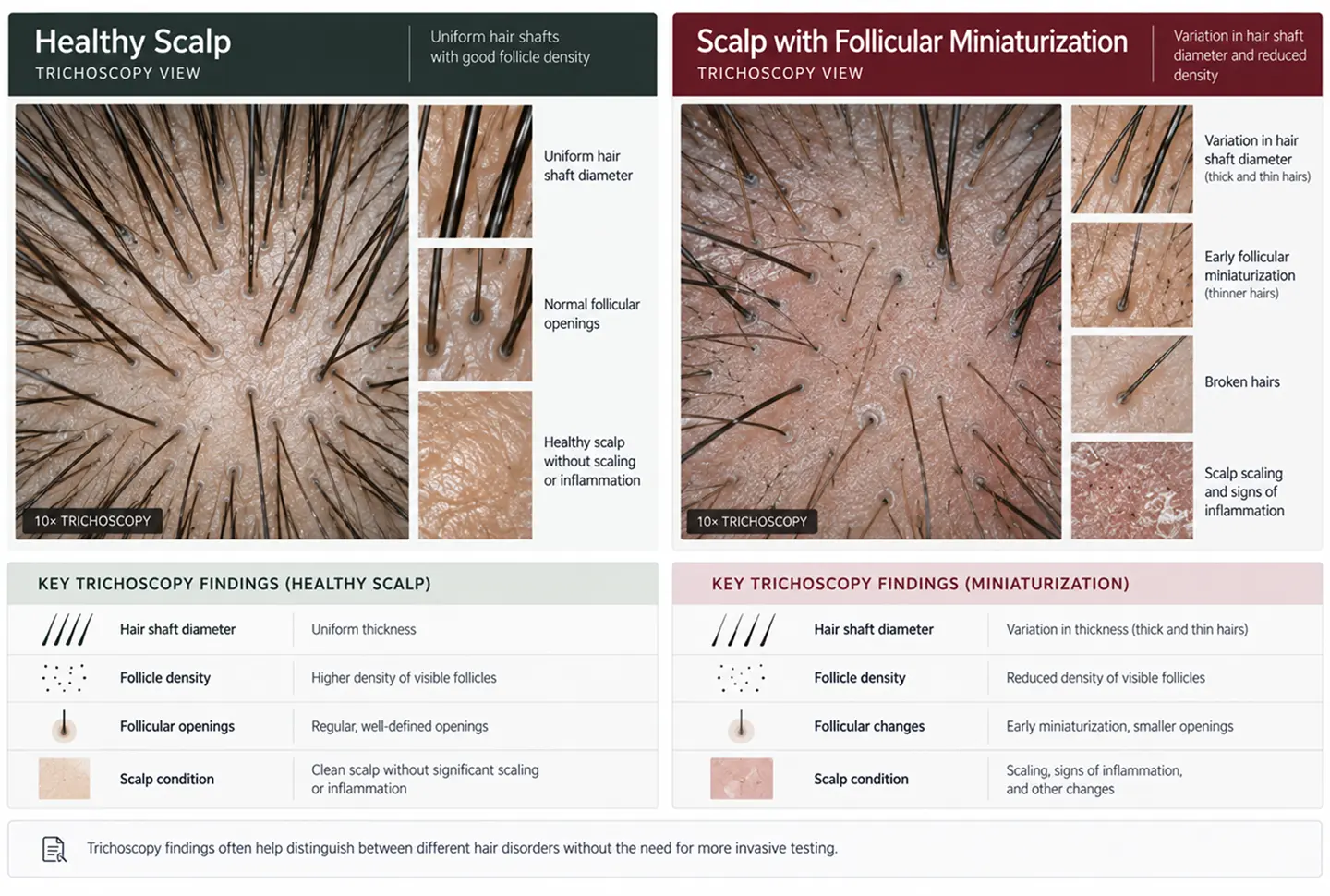
Trichoscopy: Beyond the Naked Eye
Questions may include:
- Variation in hair shaft diameter
- Early follicular miniaturization
- Signs of inflammation
- Broken hairs
- Follicular openings
- Scalp scaling
- Features suggestive of specific forms of alopecia
Laboratory Testing
- Iron stores
- Vitamin deficiencies
- Thyroid function
- Hormonal balance
- Autoimmune markers
- Other medical conditions that can contribute to hair loss
Scalp Biopsy
Monitoring Hair Loss Over Time
Why Diagnosis Comes Before Treatment
One of the most common misconceptions about hair restoration is that there is a single treatment that works for everyone. In reality, successful treatment depends on identifying the underlying cause of hair loss before therapy begins.
For example, medications that help slow the progression of androgenetic alopecia are unlikely to be effective for stress-related telogen effluvium. Likewise, inflammatory scarring alopecia’s often require prompt medical treatment to protect the remaining follicles, while some nutritional or hormonal causes of hair loss improve only after the underlying deficiency or imbalance has been corrected. An accurate diagnosis allows treatment to be tailored to the individual rather than the symptom alone. It also helps establish realistic expectations, identify conditions that require ongoing monitoring, and ensure that patients receive the most appropriate combination of medical, regenerative, or surgical therapies.