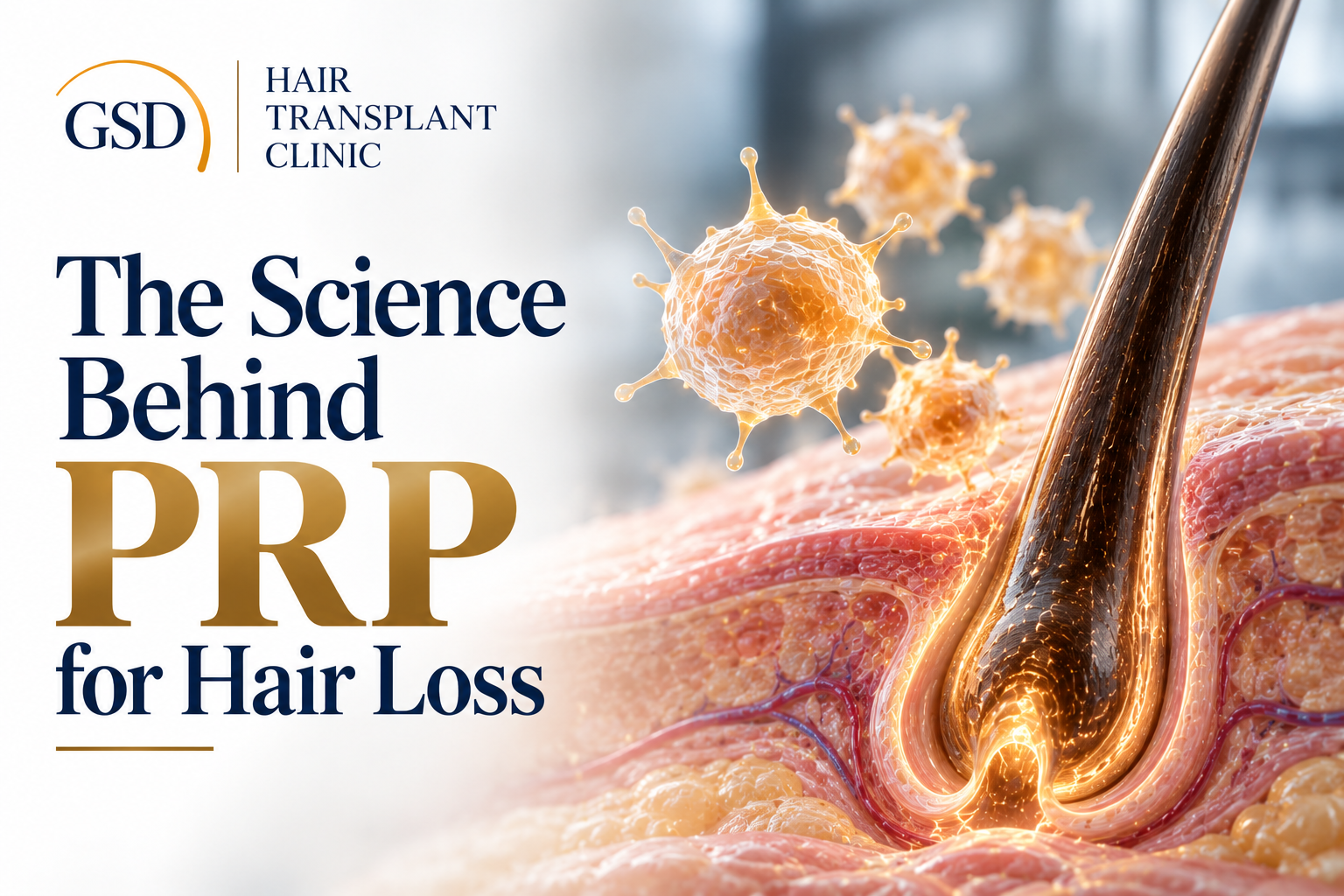
Platelet-rich plasma, commonly known as PRP, is often described as a treatment that uses a patient’s own blood to stimulate hair growth. While technically correct, that description leaves out most of the interesting science. PRP is better understood as a method of concentrating platelets and the biological signaling molecules stored within them and delivering those signals into an area where hair follicles are still present. Platelets are best known for helping blood clot after an injury. But platelets are also remarkably active biological structures. They contain proteins, growth factors, cytokines and other molecules that help coordinate tissue repair. When platelets become activated, they release these signals into the surrounding tissue, where they can communicate with nearby cells. In the scalp, researchers are particularly interested in how these signals may affect the dermal papilla, follicular stem-cell environment, blood vessels surrounding the follicle, and molecular pathways controlling the hair-growth cycle
PRP doesn’t “put growth factors into the hair.” It influences a living biological system
What Exactly Is PRP?
Blood is composed of several major components, including red blood cells, white blood cells, platelets and plasma. To prepare PRP, a patient’s blood is collected and placed into a centrifuge. The centrifuge spins the blood at carefully controlled speeds, separating its components largely according to differences in density. A platelet-enriched portion of the plasma can then be isolated. The goal is a preparation containing a greater concentration of platelets and therefore a concentrated reservoir of platelet-associated signaling molecules than is normally present in circulating blood. But concentrating the platelets is only the beginning.
Inside the Platelet: The Importance of Alpha Granules
Platelets contain several types of intracellular granules. For PRP, the most important are structures called alpha granules. Think of an alpha granule as a microscopic biological storage compartment. Inside are numerous proteins that can participate in tissue repair and cellular communication. The various growth factors associated with platelet alpha granules and PRP are the following:
Platelet-Derived Growth Factor (PDGF):
PDGF participates in cell migration and proliferation and helps coordinate tissue repair. It can also influence fibroblasts and other cells within the surrounding tissue environment.
Vascular Endothelial Growth Factor (VEGF):
VEGF is one of the body’s important regulators of angiogenesis, the process through which blood vessels form and remodel. This is relevant because an actively growing hair follicle is metabolically demanding and is closely associated with a vascular network.
Insulin-Like Growth Factor-1 (IGF-1):
IGF-1 participates in cellular survival and proliferation and is associated with maintenance of the anagen, or active growth, phase of the hair cycle.
Fibroblast Growth Factors (FGFs):
This is a family of signaling proteins rather than a single molecule. Certain FGFs are involved in follicular biology. FGF-7, for example, is associated with signaling that supports the growth phase of the follicle.
Epidermal Growth Factor (EGF):
EGF interacts with cellular receptors involved in proliferation and differentiation. Its effects depend upon the cell type, concentration and surrounding biological environment.
Transforming Growth Factor Beta (TGF-β):
TGF-β is a particularly complex signaling molecule involved in extracellular-matrix regulation, inflammation, cellular differentiation and tissue remodeling. Its effects are highly dependent upon biological context.
Platelets contain additional signaling molecules as well. PRP is not delivering one growth factor with one function. It introduces a collection of signals capable of interacting with several cellular systems simultaneously.
Activation: How Does a Platelet Actually Release Its Growth Factors?
This is one of the most interesting parts of PRP biology. Growth factors stored inside alpha granules are useful only if they can be released. That process begins with platelet activation. Under normal circumstances, platelets circulate through the bloodstream in a relatively inactive state. When tissue is injured, platelets encounter signals associated with that injury. These interactions trigger receptors on the platelet surface and initiate a rapid series of biochemical changes inside the platelet. The platelet changes shape and internal calcium signaling increases. The platelet’s internal machinery then moves its granules toward the outer cell membrane. The membrane surrounding an alpha granule subsequently fuses with the platelet’s outer membrane. Its stored proteins can then be released outside the platelet. This process is called degranulation.
So, in simplified sequence: Platelet activation → intracellular signaling → granule movement → membrane fusion → release of growth factors.
Once released, those growth factors become available to interact with receptors on nearby cells. PRP does not necessarily have to be chemically activated before it is injected. Components naturally present in tissue, including collagen and endogenous thrombin generated through the body’s coagulation system, can contribute to platelet activation after administration. Some PRP protocols instead use substances such as calcium compounds or thrombin to initiate or modify activation before application. This distinction is scientifically important because how and when platelets are activated can influence how their biological contents become available to surrounding tissue.
Growth Factors Are Signals, Not Building Materials
A growth factor does not become part of a new hair. Instead, a growth factor behaves more like a molecular instruction. Cells have receptors on their surfaces. A particular growth factor can bind to its corresponding receptor somewhat like a key interacting with a specific lock. That receptor interaction transmits information through the cell membrane and activates a series of biochemical reactions inside the cell. These intracellular signaling pathways can ultimately influence which genes become more or less active. The cell may then change its behavior. Depending upon the signal and the cell receiving it, the response might include the following:
- increased cell division
- increased cell survival
- migration toward an area of tissue repair
- changes in extracellular-matrix production
- formation or remodeling of blood vessels
- changes in differentiation and cellular function.
This is where PRP becomes particularly relevant to hair biology.
The Hair Follicle Is a Miniature Organ
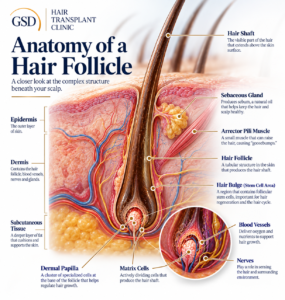
A hair follicle is not simply a tube that produces hair. It is a highly organized miniature organ containing multiple populations of specialized cells. One of its most important structures is the dermal papilla, located at the base of the follicle during active growth. Dermal papilla cells act somewhat like a biological command center. They exchange molecular signals with neighboring cells and play an important role in determining whether the follicle grows, how long it remains in its growth phase and characteristics of the hair shaft it produces. Another critical region is the follicular bulge, which contains stem cells capable of participating in regeneration of the lower portion of the follicle as a new growth cycle begins. For hair to grow normally, these different cellular populations must communicate with one another. PRP is thought to influence parts of this communication network rather than acting directly upon the visible hair shaft.
From Growth Factor to Hair Follicle: What Happens Next?
Once platelet-derived factors have been released into the tissue, they can interact with receptors on cells within and around the follicle. Experimental research has found that PRP can influence several important intracellular signaling pathways, including what is referred to as ERK, Akt and Wnt/β-catenin-related signaling. This sounds complicated, but their basic functions can be understood.
ERK: Encouraging Cellular Activity
The ERK pathway is involved in transmitting growth signals from receptors at the cell surface toward the nucleus. When appropriately activated, ERK signaling can encourage cells to proliferate and participate in tissue growth and repair. In experimental models involving dermal papilla cells, PRP has been associated with increased ERK activity.
Akt: Helping Cells Survive
The Akt pathway is strongly associated with cellular survival. Cells constantly receive signals determining whether they should remain active, divide, differentiate or undergo programmed cell death, a process called apoptosis. Akt signaling can promote survival and suppress some pro-apoptotic signals. For a miniaturizing follicle, maintaining the viability and function of important follicular cells may be relevant to sustaining an active growth phase.
Wnt/β-Catenin: A Major Hair-Follicle Signaling System
One of the most important signaling systems in hair biology is the Wnt/β-catenin pathway. When this pathway is appropriately activated, β-catenin can accumulate within the cell and participate in regulating genes associated with follicular growth and regeneration. Wnt/β-catenin signaling plays an important role in communication between dermal papilla cells and follicular stem-cell populations and is involved in the transition toward active hair growth. Experimental PRP research has demonstrated increased β-catenin activity in dermal papilla cells, providing one potential explanation for how platelet-derived signals may influence the follicular growth cycle. This does not mean that PRP simply “switches on Wnt and grows hair.” Human follicular biology is much more complicated. Rather, these findings help explain some of the molecular pathways through which PRP may exert biological effects.
VEGF and the Blood Supply Around a Growing Follicle
There is another part of the story: blood vessels. An actively growing follicle requires oxygen, nutrients and metabolic support. During anagen, the growth phase, the vascular environment surrounding the follicle becomes particularly important. VEGF can stimulate endothelial cells which are the cells lining blood vessels and promote angiogenesis and vascular remodeling.
Increasing VEGF signaling around a follicle may therefore help support the vascular environment associated with active hair growth. Again, PRP should not be reduced to the claim that it “increases circulation.” VEGF-mediated angiogenesis is a regulated cellular process involving communication between vascular and surrounding tissues.
PRP and the Hair-Growth Cycle
Every hair follicle cycles through periods of growth, transition and rest and shedding.
Anagen is the active growth phase.
Catagen is the transition phase during which the lower follicle begins to regress.
Telogen is the resting phase.
Exogen is when the hair sheds and the follicle begins to develop a new hair.
In androgenetic alopecia, genetically susceptible follicles gradually undergo miniaturization. The anagen phase tends to become shorter, and the follicle produces progressively finer and shorter hairs. PRP research suggests that platelet-derived signaling may support processes associated with anagen, including dermal papilla activity, cellular proliferation, cell-survival signaling and the vascular environment surrounding the follicle. The goal is therefore not simply to “make hair grow faster but to potentially influence the biological environment controlling the follicle’s growth cycle.
Why Miniaturization Matters
This helps explain one of the most important limitations of PRP. A miniaturized follicle and an absent follicle are not the same thing. A follicle affected by androgenetic alopecia may become extremely small yet remain biologically present. That gives treatments aimed at follicular biology something to work with. An area in which functional follicles are no longer present presents a fundamentally different problem. PRP does not manufacture an entirely new population of permanent hair follicles. That is one reason PRP and hair transplantation serve very different purposes.
PRP and Hair Transplantation Are Biologically Different
A hair transplant physically relocates healthy donor follicles from one portion of the scalp to another. PRP does not relocate follicles. Instead, PRP attempts to modify the biological environment of follicles already present in the scalp. For some patients, preserving and supporting existing hair may be an important part of long-term treatment. For others, transplantation may be necessary to restore hair to areas where sufficient follicles no longer exist. And in some situations, surgical and nonsurgical approaches may form different parts of a longer-term hair restoration strategy.
Why Not All PRP Is Necessarily the Same
One of the most important issues in PRP science is standardization. The biological composition of PRP can vary according to the patient’s baseline platelet count, the collection system, centrifugation technique, final platelet concentration, plasma volume, leukocyte content and activation method. That means two preparations both called “PRP” can be biologically different. And importantly, a higher platelet concentration does not automatically mean a better treatment. Biology rarely follows the rule that if some is good, more must be better. Cells respond to signaling molecules within particular concentration ranges, and multiple signals can interact with one another. This variability is one reason PRP research continues to evolve.
A More Accurate Way to Think About PRP
Perhaps the easiest way to understand PRP is not to think of it as a substance that “grows hair.” Think of it as a concentrated biological signaling system. The platelets provide the delivery vehicles. The alpha granules contain many of the signaling molecules. Activation triggers their release. Growth factors bind to receptors. Those receptors initiate intracellular signaling. Those signals can influence dermal papilla cells, follicular stem-cell activity, cellular survival, tissue remodeling and the vascular environment surrounding the follicle.
And all of this occurs within the much larger biological system controlling the hair-growth cycle and that is the real science behind PRP.
The Science Is Promising and It Is Still Evolving
PRP is scientifically interesting precisely because it involves multiple biological mechanisms rather than a single drug acting on a single target. But that complexity also requires appropriate expectations. Researchers are still investigating which PRP preparations are optimal, what platelet concentrations are most useful, whether particular activation methods matter, which treatment intervals are preferable and which patients are most likely to respond.
Understanding the biology allows PRP to be considered for what it actually is: a sophisticated autologous treatment designed to use the signaling capabilities of a patient’s own platelets to influence the environment of living hair follicles.
If you are interested in non-surgical hair restoration and PRP, contact us today for an evaluation to discover if it is an appropriate treatment for you.