
Testosterone has an interesting reputation when it comes to men’s hair. It is essential for normal male physiology and contributes to beard and body-hair development, yet androgens are also central to the most common form of scalp hair loss in men. This apparent contradiction raises several questions. Does having high testosterone make a man bald? Can low testosterone cause hair loss? Will testosterone replacement therapy accelerate thinning? What happens when testosterone levels are pushed well beyond the normal physiologic range with anabolic steroids? And if testosterone is involved, why do some men with high testosterone retain a full head of hair while other men begin losing hair at a relatively young age?
The answer lies not simply in how much testosterone is circulating in the bloodstream, but in what genetically susceptible hair follicles do in response to androgens. Understanding that relationship requires looking at testosterone, dihydrotestosterone (DHT), androgen receptors, genetics, and the biology of the hair follicle together.
Testosterone Is Not Simply a “Hair-Loss Hormone”
Testosterone is the principal androgen in men. It is produced primarily by the testes, with smaller contributions from the adrenal glands and peripheral conversion of other hormones. It plays important roles in sexual development and function, muscle and bone maintenance, red-blood-cell production, mood and energy, body composition, and numerous other physiological processes. Its effects on hair are particularly interesting because androgens do not affect every hair follicle in the same way.
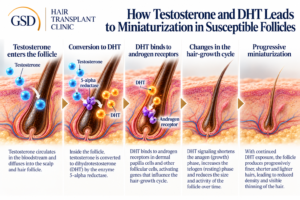
During puberty, rising androgen levels stimulate the transformation of fine hairs into thicker, darker terminal hairs in areas such as the beard, chest, and body. Yet in a genetically susceptible scalp, androgen signaling can produce essentially the opposite effect: large terminal follicles gradually become smaller. This process is called follicular miniaturization, and it is the biological foundation of androgenetic alopecia, or male pattern hair loss. So testosterone does not simply “grow hair” or “cause hair loss.” Its effect depends heavily upon where the follicle is located and how that follicle is genetically programmed to respond to androgen stimulation.
Testosterone, DHT, and the Hair Follicle
Much of the discussion about testosterone and hair loss eventually leads to dihydrotestosterone, or DHT. DHT is a more potent androgen produced when the enzyme 5-alpha-reductase converts testosterone into dihydrotestosterone within certain tissues. DHT binds strongly to androgen receptors. In scalp follicles genetically predisposed to androgenetic alopecia, this signaling contributes to progressive miniaturization. With successive hair cycles, the growth phase becomes shorter. The follicle produces a progressively shorter and finer hair. Eventually, a robust terminal hair may become so small and lightly pigmented that it contributes very little towards visible coverage. This process does not occur uniformly across the scalp.
Follicles in the frontal scalp, temples, midscalp, and crown may be genetically susceptible, while follicles in the traditional permanent donor region at the back and sides of the scalp are generally much more resistant to androgen-driven miniaturization. That biological difference is also what makes modern hair transplantation possible: appropriately selected donor follicles tend to retain much of their original resistance when moved to another area of the scalp.
Does High Testosterone Cause Baldness?
This is where the common explanation becomes too simplistic. A man does not necessarily lose his hair because his testosterone level is “too high.” Men with perfectly normal testosterone levels can develop advanced androgenetic alopecia. Conversely, a man with testosterone toward the upper end of the normal range may maintain excellent scalp density well into older age. The variable is found in follicular susceptibility. Genetics influence how scalp follicles respond to androgen signaling. Androgen-receptor biology, local 5-alpha-reductase activity, DHT exposure, age, and other molecular factors all contribute to the process. This helps explain why a single testosterone blood test is not a test for male pattern baldness. A laboratory value tells us something about circulating hormone concentration. It does not tell us how every follicle on that individual’s scalp will respond to those hormones over the next twenty years.
What Happens When Testosterone Is Very High?
Although naturally occurring testosterone in the high-normal range does not automatically cause hair loss, increasing androgen exposure can become relevant in a man who is genetically susceptible to androgenetic alopecia. More available testosterone can provide additional substrate for conversion to DHT. Depending on the individual, increased androgen signaling may accelerate a miniaturization process that was already genetically programmed to occur. Approximately 50 % of all males are naturally genetically susceptible to some degree of balding. This is one reason some men notice increased shedding or faster progression of pattern hair loss after beginning exogenous testosterone. It does not mean that every man receiving testosterone will lose his hair. A man whose scalp follicles are relatively resistant to androgen-driven miniaturization may experience little or no obvious change. Another man with strong genetic susceptibility may notice that thinning progresses more rapidly. The medication may therefore reveal or accelerate a predisposition rather than create the underlying genetic condition.
Testosterone Replacement Therapy (TRT) and Hair Loss
Testosterone replacement therapy, or TRT, is prescribed to selected men with clinically diagnosed testosterone deficiency. Hair loss is sometimes a concern when treatment begins. If testosterone therapy raises androgen exposure, DHT levels may also change because some testosterone is converted through 5-alpha-reductase. In a man with androgen-sensitive scalp follicles, this could potentially accelerate androgenetic alopecia. But TRT does not mean inevitable baldness. The response depends upon the individual’s genetics, baseline hair characteristics, age, degree of existing miniaturization, treatment regimen, resulting hormone levels, and other factors. This is also why stopping medically necessary testosterone simply because hair thinning appears is not a decision that should be made without discussing it with the prescribing physician.
The underlying hormonal condition and the patient’s overall health need to remain part of the conversation. For a patient concerned about hair while receiving TRT, the more useful question is: Is androgenetic alopecia occurring, how rapidly is it progressing, and what can reasonably be done to preserve susceptible hair? That requires examining the hair and not simply looking at the testosterone level.
Anabolic Steroids Are a Different Situation
Anabolic-androgenic steroids deserve separate discussion. Although testosterone itself is an anabolic-androgenic steroid, the term “anabolic steroids” commonly refers to testosterone or synthetic androgenic compounds used often without medical indication to increase muscle mass or athletic performance. These drugs can expose the body to androgenic activity far beyond normal physiological levels, depending on the substances and doses involved. For a man genetically predisposed to androgenetic alopecia, that can be particularly relevant. Certain anabolic compounds are themselves strongly androgenic. Others may interact differently with androgen receptors or undergo different metabolic pathways. It is therefore inaccurate to assume that every anabolic steroid affects scalp hair identically or that DHT conversion is the only mechanism of concern. The practical point is simpler and that is that substantially increasing androgenic stimulation may accelerate genetically susceptible hair loss. And once significant follicular miniaturization has occurred, simply discontinuing the androgen does not guarantee that every affected follicle will completely recover. Nonmedical anabolic steroid use also carries health risks extending well beyond hair, including cardiovascular, endocrine, reproductive, hepatic, and psychiatric effects depending on the agents used. Hair preservation should not be considered in isolation from those broader risks.
What About Low Testosterone?
The opposite question is equally interesting. If high androgen exposure can accelerate male pattern hair loss in susceptible men, does low testosterone protect the scalp or cause a different kind of hair loss? Again, biology is more complicated than a simple high-versus-low equation. Men with testosterone deficiency may experience changes in body composition, sexual function, energy, mood, bone health, and other physiological systems. Reduced androgen stimulation may also affect beard and body-hair characteristics in some men. Diffuse scalp thinning, however, should not automatically be attributed to low testosterone. A man with low testosterone can still have androgenetic alopecia. He can also develop telogen effluvium, thyroid-related hair loss, nutritional deficiencies, inflammatory scalp disease, medication-associated shedding, or other conditions unrelated to his testosterone level. If hair loss is diffuse or atypical, the appropriate response is not to assume that testosterone is responsible. The pattern and underlying cause need to be identified.
Why Some Men Lose Hair and Others Do Not
Two brothers can have different degrees of hair loss. A father can retain most of his hair while his son develops significant recession. A man with high testosterone can have dense hair, while another with average hormone levels develops extensive male pattern loss. Androgenetic alopecia is polygenic, meaning that numerous genes contribute to susceptibility. The androgen receptor gene is important, but it is not the entire story, and genetic influences can come from both sides of the family. This is why the familiar idea that a man can predict his future hair simply by looking at his maternal grandfather is unreliable. Family history remains useful, but it is not destiny written in a single relative’s hairline.
What We Look for When Testosterone and Hair Loss Intersect
When a man presents with hair loss and is taking testosterone or is concerned that hormones may be contributing, the scalp itself provides important information. Is the hairline receding? Are the temples becoming progressively thinner? Is there miniaturization in the frontal scalp or crown? Is the donor region stable and Is the patient experiencing true pattern loss or generalized shedding? Under magnification, trichoscopy can reveal differences in hair-shaft diameter and progressive miniaturization that may not yet be obvious in the mirror. The patient’s medical history also matters. Testosterone therapy, anabolic steroid exposure, medications, recent illness, weight change, nutrition, endocrine disease, and family history may all contribute useful information. Laboratory testing may be appropriate when the clinical history suggests an endocrine, nutritional, or systemic abnormality, but testing should answer a medical question rather than substitute for examining the hair and scalp.
Can Androgen-Related Hair Loss Be Slowed?
For appropriately selected patients, medical therapy may help preserve vulnerable non-transplanted hair. Medications such as Finasteride reduces conversion of testosterone to DHT by inhibiting 5-alpha-reductase. Dutasteride inhibits additional forms of the enzyme and produces greater DHT suppression, although treatment decisions, regulatory status, potential adverse effects, and individual circumstances need to be considered with a physician. Minoxidil works through a different mechanism and does not lower testosterone or DHT.
These treatments do not change a person’s genetic predisposition. Their purpose is to alter the biological environment of susceptible follicles and potentially slow miniaturization or improve growth while treatment is continued. Not every treatment is appropriate for every patient, and the risks, benefits, alternatives, and expectations should be discussed individually.
Testosterone Also Matters When Planning a Hair Transplant
Hair transplantation can replace hair in areas where significant loss has already occurred, but it does not stop susceptible native follicles from continuing to miniaturize. This becomes particularly important in a younger man with active androgenetic alopecia or in someone using exogenous androgens. A hairline designed without considering future loss can look appropriate initially and increasingly unnatural if the non-transplanted hair behind it continues to disappear. Donor hair is also finite. The objective is therefore not simply to fill today’s thinning area. A well-designed transplant considers the likely progression of hair loss, stability of the donor region, available donor supply, age, medical treatment when appropriate, and how transplanted and non-transplanted hair may coexist years into the future.
This lifetime perspective has been central to Dr. Paul Rose’s work in hair restoration. His experience with follicular-unit transplantation, natural hairline design, donor management, repair procedures, and complex cases reflects a fundamental principle: technically successful graft placement is only one component of an excellent long-term result.
In Conclusion
When men hear that DHT contributes to male pattern baldness, it is easy to conclude that more testosterone equals more DHT and therefore more baldness, but human biology is rarely that linear. Testosterone is part of the mechanism, but genetic susceptibility of the follicle determines much of the response. DHT is important, but it is not meaningful without an androgen-sensitive follicle. Exogenous testosterone or anabolic-androgenic steroids may accelerate loss in susceptible men, but they do not produce identical effects in everyone. Low testosterone, meanwhile, does not provide a simple explanation for every form of thinning. The first step is therefore not to blame a hormone. It is to determine what type of hair loss is occurring, whether follicles are actively miniaturizing, what factors may be accelerating the process, and which hairs remain capable of being preserved.
At Golden State Hair Transplant Clinic, evaluation comes before determining whether medical therapy, hair transplantation or a combination of approaches, is most appropriate for men who are noticing hair loss while taking testosterone. A detailed evaluation of the hair, scalp, medical history, and pattern of progression can provide far more useful information than a testosterone level alone. Early intervention to counteract and help prevent loss is important to the preservation and protection of viable follicles. If you are experiencing hair loss and are looking for solutions, Golden State can help.