Step 02 — Personalized Plan

A Plan Built Around You

Your personalized plan goes beyond simply choosing a procedure, it’s a complete roadmap designed around you, your individual circumstances, hair characteristics and future needs.

A personalized treatment plan shaped around your hair-loss pattern, individual characteristics, aesthetic goals, and long-term needs.

Your Hair Characteristics

We take into account your hair density, caliber, texture, and growth pattern, as well as the strength and quality of your donor area, to determine which treatment, technique or procedures and graft will deliver the most natural and lasting results.

Your Goals

Whether your priority is restoring a hairline, adding density to thinning areas, or achieving maximum coverage, your plan is shaped around your goals and individual circumstances.

Your Long-Term Needs

Hair loss can progress over time, so your plan takes into consideration the type of hair loss, possible progression, areas of thinning, donor area preservation, and how your results will look years down the road, not just immediately after your procedure.

Every Detail Considered

From graft count and placement pattern to recovery timeline and maintenance recommendations, every element of your plan is customized, so you know exactly what to expect at each step.

Your Personalized Hair Restoration Plan

No two patients experience hair loss in exactly the same way. A personalized hair restoration plan brings together the findings from your consultation, your individual hair characteristics, your aesthetic priorities, and the likely progression of your hair loss. The objective is not simply to address the areas that concern you today. It is to develop a thoughtful, long-term strategy that uses your available donor hair responsibly, preserves future options, and creates results that remain natural as your appearance and hair-loss pattern evolve.

Confirming the Diagnosis

The first consideration is the cause of your hair loss. Pattern hair loss, scarring alopecia, traction-related hair loss, inflammatory scalp disease, and other conditions require different approaches. Before recommending transplantation, it is important to determine whether the hair loss appears stable and whether the scalp can safely support transplanted follicles. If additional evaluation or treatment is needed, this may become the first stage of your plan.

Step - 1

Step - 2

Evaluating Your Individual Hair Characteristics

Several physical characteristics influence how a hair transplant should be planned and what degree of coverage may be achievable. These include Donor-hair density, hair-shaft thickness, hair color and the degree of contrast with the scalp, straight, wavy, or curly hair texture, the size and condition of the donor area, existing hair within the proposed recipient area and the pattern and extent of thinning These characteristics affect both the number of grafts that may be available and the visual coverage those grafts can create. For example, thicker or curlier hair may provide greater visual coverage than fine, straight hair using a similar number of follicles.

Defining Your Priorities

Your plan should reflect what matters most to you. Some patients are primarily concerned with rebuilding the frontal hairline, while others want to improve the appearance of density through the frontal scalp, mid scalp, crown, or a combination of areas. When donor hair is limited or hair loss is extensive, it may not be advisable to treat every area with equal density. Establishing clear priorities helps direct the available grafts to the areas where they can create the most meaningful and natural-looking improvement.

Step - 3

Step - 4

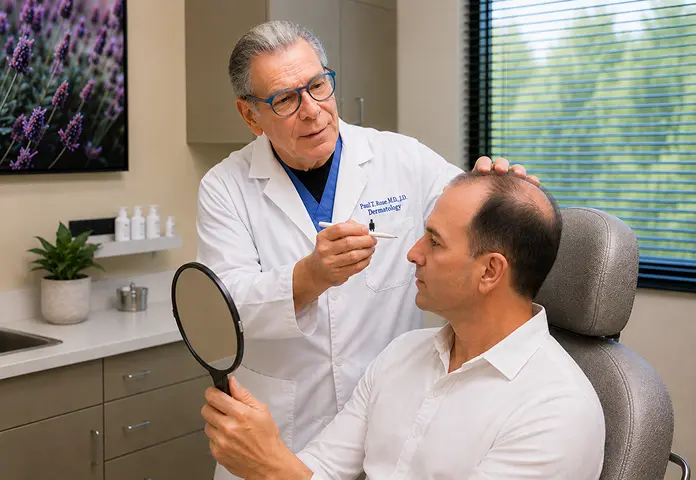
Designing the Hairline and Recipient Area

Hairline design is one of the most important elements of a natural-looking hair transplant. The proposed design is considered in relation to your facial proportions, age, existing hair, degree of recession, and anticipated future hair loss. A well-designed hairline should complement the face without appearing unnaturally low, perfectly symmetrical, or overly dense. The transition at the front should be soft and refined, with careful attention to the placement, angle, direction, and distribution of individual follicles. The plan will also identify the areas behind the hairline that require coverage and determine how grafts can be distributed to create a balanced visual result.

Assessing the Donor Supply

Donor hair is a limited and valuable resource. Once follicles are removed from the donor area, they do not grow back in that location. The plan must therefore consider not only how many grafts can be obtained, but how many can be removed safely without leaving the donor area visibly depleted. The quality, density, and long-term stability of the donor hair are evaluated to determine the approximate number of usable grafts, which areas of the donor region are safest to use, how graft removal may affect the donor area, whether donor hair should be reserved for possible future procedures and whether your goals are realistic within the available supply Responsible donor management is especially important for younger patients and for those with progressive or extensive hair loss.

Step - 5

Step - 6

Selecting the Surgical Technique

If hair transplantation is recommended, the plan will identify whether follicular unit extraction (FUE), follicular unit transplantation (FUT), or a carefully selected combination of approaches is most appropriate. With FUE, follicular units are removed individually from the donor area. With FUT, a narrow strip of donor tissue is removed and carefully divided into individual follicular-unit grafts. Each technique has distinct considerations relating to donor preservation, hairstyle preferences, healing, scarring, and the number of grafts required. The appropriate technique is recommended according to your individual anatomy and long-term needs.

Determining Graft Placement and Distribution

The number of grafts is only one part of treatment planning. Where those grafts are placed and how they are distributed has a significant effect on the final appearance. Your personal plan considers the number of grafts required for each treatment area, the appropriate density required for a hairline and areas behind it if rebuilding the hairline is required, The natural direction and angle of hair growth and the transition between transplanted and existing hair and the best way to create the strongest visual improvement with the available donor supply Strategic placement can often create the appearance of greater coverage without using grafts unnecessarily.

Step - 7

Step - 8

Planning for Existing and Future Hair Loss

Transplanted follicles may be permanent, but the patient’s surrounding, non-transplanted hair can continue to thin. This possibility must be considered when determining the location of the hairline, the size of the treatment area, and the number of grafts used. Where appropriate, medical therapy or other nonsurgical treatments may be recommended to help preserve existing hair and support the overall restoration plan. Some patients may also require a staged approach in which treatment is performed over time rather than attempting to address every concern in a single procedure.

Setting Realistic Expectations

Before proceeding, you will receive a clear explanation of what the proposed plan is designed to accomplish. This includes the areas expected to improve, the approximate degree of coverage, the limitations created by donor supply, and the possibility that additional treatment may be appropriate in the future. Hair transplantation redistributes existing follicles; it does not create an unlimited new supply of hair. A carefully developed plan balances the improvement you would like to achieve with what can be accomplished safely, naturally, and responsibly.

Step - 9

Step - 10

Reviewing the Plan Together

Your proposed plan will be reviewed with you so that you understand the recommended treatment areas, surgical technique, anticipated graft requirements, recovery considerations, and long-term strategy. You will also have an opportunity to ask questions and discuss any concerns before making a decision. The plan can be refined when appropriate to ensure that it reflects both sound medical and surgical judgment and your personal goals.

A Plan Designed for You

A personalized hair restoration plan provides the blueprint for every stage of treatment. By considering diagnosis, facial structure, hair characteristics, donor limitations, aesthetic priorities, and the potential for future hair loss, Golden State Hair Transplant can develop an approach intended to create natural-looking improvement while protecting your long-term options.