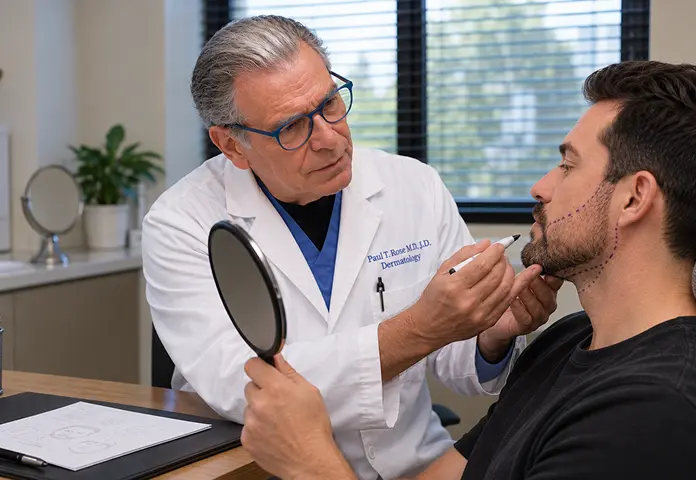
What Is a Beard or Mustache Transplant?
A beard or mustache transplant uses a patient’s own hair follicles to create new facial hair growth in areas where greater coverage or definition is desired. Follicular grafts are generally harvested from the back or sides of the scalp, where the hair is most resistant to thinning. The grafts are then placed individually into carefully planned recipient sites within the beard, mustache, sideburns, goatee, or other areas of the face. Each site is created with close attention to angle, direction, spacing, and depth so that the transplanted hair follows the natural growth pattern of facial hair.
What Can Facial Hair Transplantation Accomplish?
The procedure may be used to Add density to a thin or patchy beard, Create a fuller mustache or goatee, Define the cheek line or lower beard border, Improve symmetry between two sides of the face., reconstruct sideburns, fill gaps where. Fill gaps where facial hair does not naturally grow., camouflage selected. Scars caused by injuries, surgery, acne or other conditions. And create a beard pattern that better reflects. Your aesthetic or gender affirming goals. Treatment may involve a small, precisely defined area or the development of a more complete beard pattern. The number of grafts required depends on the existing facial hair, the size of the treatment area, donor-hair characteristics, and the degree of density the patient hopes to achieve.
Designing a Natural Beard or Mustache
Facial hair transplantation requires more than simply placing follicles into an area of sparse growth. Beard and mustache hairs emerge from the skin at very acute angles and change direction across different regions of the face. The pattern along the cheeks, jawline, chin, upper lip, and sideburns must therefore be designed and transplanted differently. Careful planning is essential. Factors that must be considered are facial proportions, existing hair growth, skin characteristics, hair texture, future grooming preferences, and the transition between transplanted and naturally occurring facial hair. The goal is a result that looks appropriate both when the hair is closely trimmed and when it is grown longer.
The Procedure
Before treatment, the desired shape and distribution of the facial hair are discussed and mapped carefully. Donor follicles are commonly obtained using follicular unit extraction, or FUE, which allows suitable grafts to be removed individually from the scalp. Recipient sites are then created in the planned facial areas. The grafts are placed one at a time, with particular attention to the direction and angle at which each hair will grow. Single-hair follicular units are especially important along visible borders, where softness and natural irregularity help prevent an overly sharp or artificial appearance.
The procedure is performed using local anesthesia. The length of treatment depends on the size of the area and the number of grafts being transplanted.
Recovery and Hair Growth
Small crusts and temporary redness may be visible around the transplanted follicles during the early healing period. Patients receive specific instructions regarding cleansing, shaving, skin care, and protection of the newly placed grafts. The transplanted hairs commonly shed during the first several weeks. This is an expected part of the process and does not mean that the follicles have been lost. New growth generally begins gradually over the following months, with density and maturation continuing to improve over time. Once established, the transplanted hairs can be washed, trimmed, shaved, and styled. Because the follicles retain many of the characteristics of the donor hair, they may grow more quickly than naturally occurring beard hair and may require regular trimming.
Is Facial Hair Transplantation Right for You?
Good candidates generally have sufficient donor hair, healthy skin in the proposed treatment area, and realistic expectations about density and growth. A medical evaluation is important, particularly when facial hair loss is sudden, unexplained, associated with inflammation, or caused by an active skin or scarring disorder.
During your consultation, Dr Rose will evaluate your existing facial hair, donor supply, skin condition, and aesthetic goals. From there, a treatment plan can be developed to create facial hair that appears natural, balanced, and uniquely suited to you.