
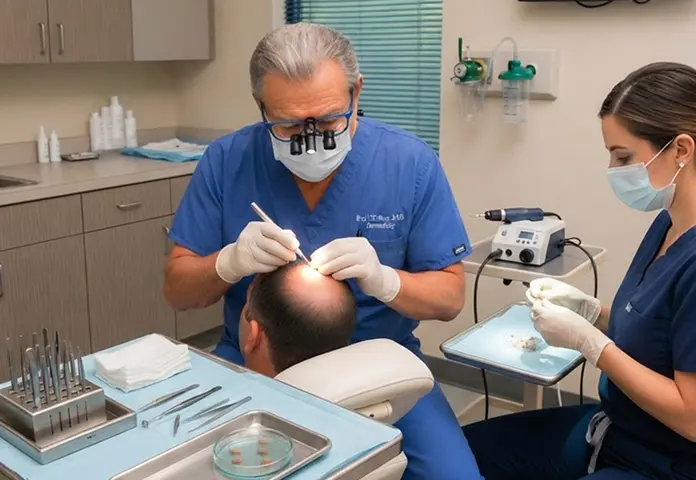
Step 03 — Procedure

Precision, Care, and Proven Technique

Your procedure day is where careful planning becomes a natural, permanent result. Every step is performed with meticulous attention to detail, using advanced techniques refined to protect graft health and deliver results that look completely natural.

Your procedure is performed with precision, artistry, and meticulous attention to detail using advanced techniques designed to create natural-looking, lasting results.

Advanced Extraction Techniques

Depending on your personalized plan, grafts are harvested using either FUE (Follicular Unit Extraction) or FUT (Follicular Unit Transplantation), each performed with precision designed to preserve the integrity of every follicle and minimize trauma to the donor area.

Natural Placement Design

Graft placement is where artistry meets technique. Each follicle is placed with careful attention to angle, direction, and density following your natural hair growth pattern, so your results blend seamlessly with your existing hair.

Comfort Throughout

Your comfort is our priority from start to finish. The procedure is performed under local anesthesia, and our team monitors you closely throughout to ensure a safe, comfortable experience.

Built for Lasting Results

Because transplanted follicles are typically resistant to the effects of hair loss, the results are designed to be permanent, giving you natural growth that lasts for years to come.

Your Hair Transplant Procedure

A hair transplant is a carefully planned surgical procedure in which healthy follicular units are moved from a stable donor area at the back and sides of the scalp to areas affected by thinning or hair loss. Whether the follicles are obtained using follicular unit extraction (FUE) or follicular unit transplantation (FUT), the fundamental goal is the same: to preserve healthy grafts and place them with meticulous attention to density, distribution, angle, direction, and natural hair-growth patterns. The primary difference between FUE and FUT is the way the donor follicles are obtained. Once the grafts have been prepared, the recipient-site creation and implantation stages are generally similar.

Reviewing the Surgical Plan

Before the procedure begins, the surgical plan is reviewed with you. The treatment areas, proposed hairline, donor region, graft requirements, and selected harvesting technique are confirmed. This final review gives you another opportunity to ask questions and ensures that you and the surgical team share a clear understanding of the objectives for the procedure.

Step - 1

Step - 2

Designing the Hairline and Treatment Area

When the frontal area is being treated, the proposed hairline is carefully marked and assessed in relation to your facial structure, age, existing hair, degree of recession, and long-term pattern of hair loss. A natural hairline is not simply a straight line across the forehead. It requires subtle variation, appropriate proportions, and a gradual transition from finer hairs at the leading edge to greater density behind it. If the midscalp, crown, or another area is being treated, the boundaries of the recipient area and the intended direction of growth are also mapped.

Preparing the Donor and Recipient Areas

The donor area is prepared according to whether FUE or FUT will be used. Depending on the technique and the individual surgical plan, some hair may need to be trimmed so that the follicles can be identified and obtained safely. The recipient area is also examined and prepared. Existing hair is preserved whenever possible, and the planned areas of graft placement are confirmed before surgery proceeds.

Step - 3

Step - 4

Administering Local Anesthesia

Local anesthesia is administered to the donor and recipient areas for your comfort during the procedure. You will feel a slight pinch lasting only a second or two while the initial anesthesia is administered after that you remains awake and can feel only pressure and movement but not pain. The clinical team monitors you throughout the procedure and takes steps to maintain your comfort throughout the entire procedure, from the donor-harvesting stage through final graft placement.

Obtaining the Donor Follicles

With FUE: In follicular unit extraction, follicular units are removed individually from the donor area using small, specialized instruments. The extractions are distributed strategically throughout the safe donor region to preserve a balanced appearance and avoid excessive depletion in any one location. Each extracted graft may contain one, two, three, or occasionally more hairs. The grafts are collected carefully and transferred for examination and preparation. FUE leaves many small extraction sites rather than a linear incision. These sites heal individually and are generally difficult to detect once healing is complete and the surrounding hair has grown.
With FUT: In follicular unit transplantation, a narrow strip of tissue containing healthy follicles is removed from the donor area. The donor incision is then carefully closed, leaving a fine linear scar that is normally concealed by the surrounding hair. The donor tissue is transferred to the graft-preparation team, where it is divided into naturally occurring follicular units under magnification. FUT may be advantageous for certain patients when a larger number of grafts is required, when preserving the broader donor area is especially important, or when the patient’s hair characteristics and long-term plan make strip harvesting the more appropriate option.

Step - 5

Step - 6

Examining and Preparing the Grafts

Once obtained, the follicular units are examined and prepared under magnification. Excess tissue is carefully trimmed while protecting the structures necessary for healthy growth. The grafts are sorted according to the number of hairs they contain and placed in a solution. Single-hair grafts are generally reserved for the leading edge of the hairline, where they help create a soft, natural transition. Grafts containing multiple hairs may be placed farther behind the hairline or in areas where greater visual density is desired.

Creating the Recipient Sites

Dr Rose creates small recipient sites within the treatment area. This is one of the most important and artistically demanding stages of the procedure because the size, depth, angle, direction, and distribution of these sites help determine how the transplanted hair will ultimately appear. Recipient sites are created to follow natural growth patterns and complement the patient’s existing hair. Particular attention is given to the irregular softness of the frontal hairline, the direction and angle of growth, the transition between transplanted and existing hair, the distribution of density, the natural change in direction within the crown and the preservation of existing follicles.

Step - 7

Step - 8

Placing the Follicular-Unit Grafts

The prepared grafts are placed individually into the recipient sites. Each follicular unit must be handled delicately to avoid damaging the follicle during placement. The grafts are distributed according to the surgical plan. Finer single-hair grafts are typically used along the leading edge, while larger follicular units are placed in selected areas to build coverage and the appearance of density. This stage requires patience and precision.

Completing a Final Examination

After the grafts have been placed, the donor and recipient areas are carefully inspected. With FUT, the donor closure is examined and postoperative instructions relating to the incision are reviewed. With FUE, the individual extraction sites are assessed, and instructions are provided for caring for the donor area as it heals.

Step - 9

Step - 10

Reviewing Your Postoperative Instructions

Before leaving, you will receive detailed instructions explaining how to protect the newly transplanted grafts and care for the donor and recipient areas. You will be given an appointment for the next morning where you will return to the office and have your first hair wash and receive instructions on how to wash and care for your scalp, you will be given temporary activity restrictions, and we will go over to expect in regard to the healing process. There will also be. Instructions for any medications and we will go over post follow up appointments and how to contact us immediately if you have any questions or concerns. Because the newly placed grafts are most vulnerable during the first several days, following these instructions carefully is an important part of the procedure.

Precision at Every Stage

A successful hair transplant depends on far more than moving follicles from one area to another. Natural-looking results require careful planning, responsible donor management, skilled graft handling, thoughtful hairline design, and precise control over every follicle’s placement.

At Golden State Hair Transplant, each stage is approached with meticulous attention to detail from donor harvesting and graft preparation to the final angle and direction of placement with the goal of creating a result that looks like you’ve never had a transplant to begin with.