
FUE Hair Transplant: Process, Recovery, and What to Expect

Hair loss affects millions of men and women across the United States, and for many, it can take a real toll on confidence and self-image. Fortunately, advances in hair restoration technology have made it possible to achieve natural, long-lasting results with minimal downtime. Among the most popular and effective options available today is the FUE hair transplant — a technique known for its precision, minimal scarring, and quick recovery. At Golden State Dermatology, we perform FUE hair transplants for patients seeking a reliable, natural-looking solution to thinning hair and hair loss. In this article, we’ll walk through exactly what FUE is, how the procedure works from start to finish, what recovery looks like, and what results patients can expect over time.

What Is FUE (Follicular Unit Extraction)?

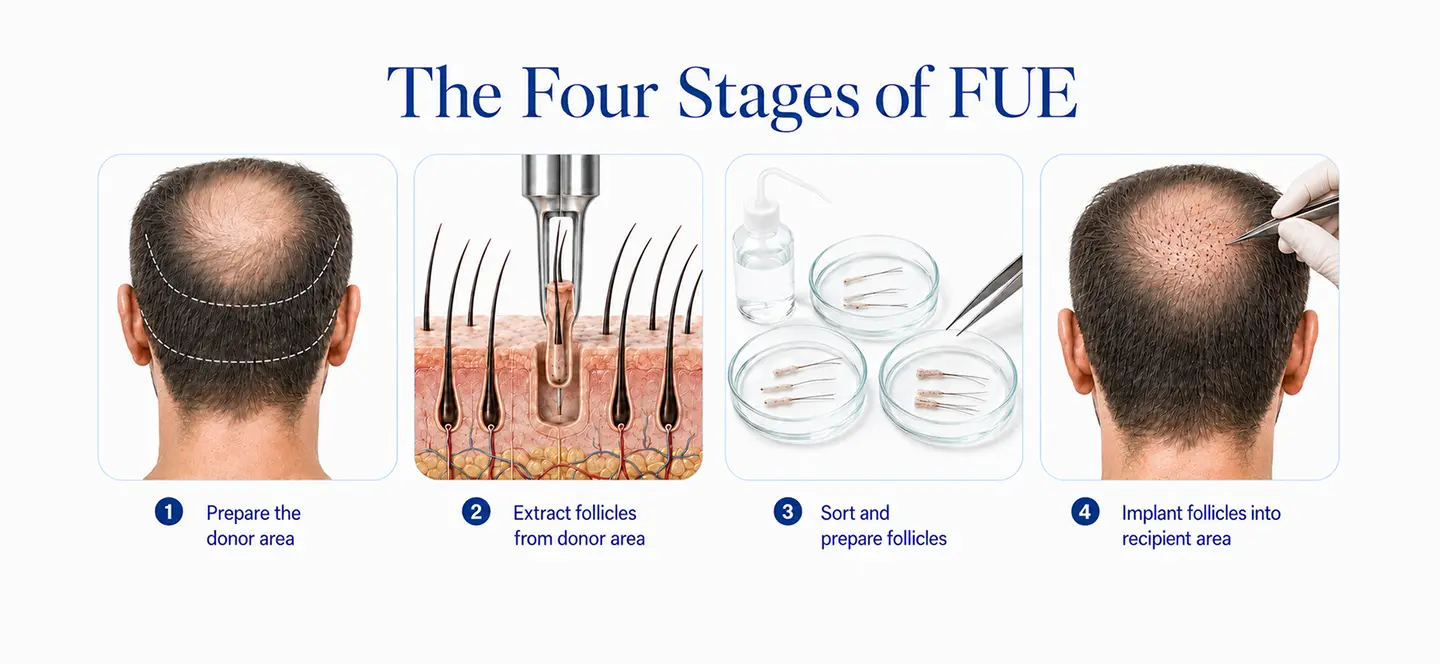
FUE stands for Follicular Unit Extraction, a modern hair transplant technique in which individual hair follicles are removed one at a time from a donor area of the scalp — typically the back or sides of the head, where hair is genetically resistant to the hormone (DHT) responsible for pattern hair loss — and transplanted into areas experiencing thinning or baldness.

Unlike the older FUT (Follicular Unit Transplantation) method, which involves removing a strip of scalp tissue and closing the donor site with sutures, FUE extracts follicles individually using a small, precise punch tool. This means there is no linear incision, no stitches, and no linear scar — just a series of tiny, virtually undetectable puncture marks that heal quickly and blend into the surrounding hair.

FUE has become one of the most requested hair restoration procedures because it offers a combination of natural results, minimal invasiveness, and a comfortable recovery process, making it an appealing option for patients who want an effective solution without extended downtime.

Who Is a Good Candidate for FUE?

Not every patient experiencing hair loss is automatically a candidate for FUE, which is why a thorough consultation with a qualified hair restoration specialist is an essential first step. Generally speaking, good candidates for FUE include patients who:
During your consultation at Golden State Dermatology, our specialists will evaluate your scalp, donor supply, hair loss pattern, and overall health history to determine whether FUE is the right fit, or whether an alternative approach — such as FUT, a Megasession, or a combination technique — may better suit your goals.

The FUE Hair Transplant Process, Step by Step

While every patient’s treatment plan is customized, the FUE procedure generally follows a consistent sequence of steps. Understanding what happens at each stage can help ease any anxiety about the process and set realistic expectations for the day of your procedure.

Step 1

Initial Consultation and Planning

Before any procedure takes place, patients undergo a detailed consultation in which the surgical team assesses hair loss pattern, donor hair density, scalp characteristics, and aesthetic goals. This is also the stage where the hairline is designed — a critical step that determines how natural the final results will look. A well-planned hairline takes into account facial proportions, age, and the natural, slightly irregular pattern of a genuine hairline.

Step 2

Preparing the Donor and Recipient Areas

On the day of the procedure, the donor area (typically the back and sides of the scalp) is trimmed short to allow for precise extraction. Local anesthesia is then administered to ensure the patient is comfortable throughout the procedure. Because FUE is performed under local anesthesia rather than general anesthesia, patients remain awake and can often relax, watch a movie, or listen to music during the several-hour process.

Step 3

Follicle Extraction

Using a specialized micro-punch tool, the surgical team extracts individual follicular units — groups of one to four hairs that grow naturally together — from the donor area. Each follicle is carefully removed to preserve its structure and viability, since graft survival depends heavily on how gently and precisely the extraction is performed. Depending on the scope of the procedure, anywhere from several hundred to several thousand grafts may be extracted in a single session.

Step 4

Graft Preparation and Storage

Once extracted, grafts are sorted, counted, and preserved in a specialized holding solution to keep them healthy while outside the body. This step requires meticulous attention to detail, as grafts are living tissue and their viability decreases the longer they remain unplanted. Experienced hair restoration teams work efficiently to minimize this “time out of body” and maximize graft survival rates.

Step 5

Creating Recipient Sites

Next, the surgeon creates tiny recipient incisions in the treatment area using a fine blade or needle. The angle, depth, and direction of these incisions are critical, as they determine the natural direction of hair growth once the transplanted follicles mature. This is one of the most artistic aspects of the procedure, requiring an experienced eye to replicate the natural growth pattern of undisturbed hair.

Step 6

Graft Implantation

Finally, the prepared grafts are carefully placed into the recipient sites one by one. The team works methodically, following the hairline design and density plan established during the consultation, to ensure an even, natural distribution of hair across the treated area. Depending on the number of grafts being transplanted, this final stage can take several hours to complete.

Step 7

Post-Procedure Care Instructions

Once the transplant is complete, the treatment area is gently cleaned, and patients receive detailed aftercare instructions covering how to care for both the donor and recipient areas during the initial healing period. Most patients are able to go home the same day, as FUE does not require an overnight hospital stay.

FUE Recovery: What to Expect Week by Week

One of the most common questions patients have is what recovery actually looks like after an FUE hair transplant. While healing time can vary from patient to patient, most people follow a fairly predictable recovery timeline.

Immediate Post-Procedure Period

In the first few days after the procedure, it’s normal to experience mild redness, swelling, and tenderness in both the donor and recipient areas. Tiny scabs will form around each graft site — this is a normal part of the healing process and should not be disturbed. Patients are typically advised to sleep with their head elevated, avoid touching or scratching the scalp, and follow a gentle cleansing routine as instructed by their provider. Most patients can return to light daily activities within a day or two, though strenuous exercise should be avoided.

Days 1–3

Days 4–10

Scabbing and Initial Healing

By the end of the first week, swelling generally subsides, and the small scabs at each graft site begin to flake off naturally. It’s important not to pick or force the scabs off, as doing so can dislodge a graft before it has properly anchored. By around day 10, most of the visible scabbing has resolved, and the transplanted area starts to look more like a typical scalp, aside from some redness.

The "Shock Loss" Phase

Around two to four weeks after the procedure, many patients notice that the newly transplanted hairs begin to shed. While this can be alarming for those unfamiliar with the process, it’s a completely normal and expected part of the hair growth cycle known as “shock loss.” The hair follicle itself remains intact beneath the skin; only the hair shaft is shed temporarily before the follicle enters a resting phase ahead of new growth.

Weeks 2–4

Months 2–4

The Waiting Period

During this stage, the scalp may appear largely unchanged, and it’s common for patients to feel impatient. Beneath the surface, however, the transplanted follicles are transitioning out of their resting phase and beginning to prepare for new growth. Patience is key during this period, as visible progress is often gradual and inconsistent from patient to patient.

New Growth Begins

Most patients start to see the first signs of new hair growth in the transplanted area around the fourth month, with continued thickening and density improvements through months six, seven, and eight. Hair during this stage may initially appear thinner or finer than surrounding hair before maturing further.

Months 4–8

Months 9–12

Final Results Take Shape

By the ninth to twelfth month, most patients see the majority of their final results, with continued refinement in thickness and texture continuing for some time afterward. While individual timelines vary, this one-year mark is generally considered the point at which the full outcome of an FUE hair transplant becomes apparent.

Tips for a Smooth Recovery

While your provider will give you specific aftercare instructions tailored to your procedure, general best practices for supporting a smooth FUE recovery include:

Benefits of Choosing FUE

FUE has become a leading choice in hair restoration for several key reasons:

Minimal scarring

Because individual follicles are extracted rather than a strip of tissue, FUE leaves only small, scattered puncture marks rather than a linear scar.

Faster recovery

Most patients return to normal daily activities within just a few days.

Versatility

FUE can be used not only for scalp hair restoration, but also for eyebrow transplants, beard transplants, and body hair transplants when scalp donor supply is limited.

Natural-looking results

With careful graft placement and hairline design, FUE can produce results that are virtually indistinguishable from natural hair growth.

Flexibility with hairstyles

Because there is no linear scar, patients can wear their hair very short without visible evidence of the procedure.

Potential Risks and Considerations

As with any surgical procedure, FUE carries some potential risks, though serious complications are uncommon when the procedure is performed by an experienced provider. Possible considerations include temporary swelling or redness, minor discomfort during the initial healing period, temporary shock loss of existing hair near the treatment site, and — in rare cases — infection or poor graft survival if aftercare instructions are not properly followed. Choosing a qualified, experienced hair restoration provider and closely following all pre- and post-procedure instructions significantly reduces these risks and supports the best possible outcome.

Conclusion

FUE hair transplantation has transformed the field of hair restoration by offering patients a minimally invasive, scar-free alternative to traditional strip harvesting methods, with a recovery process that fits comfortably into most patients’ lives. From the initial consultation and hairline design through follicle extraction, graft placement, and the months-long healing and regrowth process, every stage of FUE is designed to produce results that look and feel completely natural.

If you’re considering a hair transplant and want to learn whether FUE is the right option for your hair loss pattern and goals, the team at Golden State is here to help. Our specialists take a personalized approach to every consultation, ensuring your treatment plan is designed around your unique scalp, hair characteristics, and desired outcome.

Ready to Find Out What's Possible?

A private consultation with Dr. Rose is the first step — no obligation, no pressure, just an honest plan.