

Step - 1
Step - 2
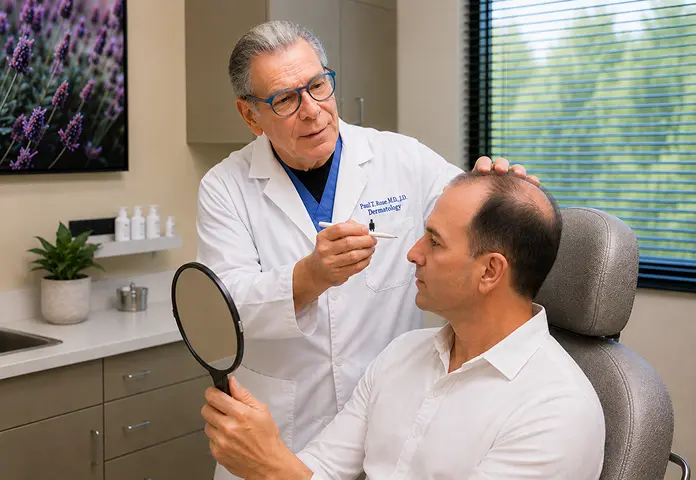
Next, we will review the history and progression of your hair loss. This may include discussing when you first began noticing hair loss and whether the changes have been gradual or sudden, areas where thinning or recession has progressed and any previous hair loss treatments or procedures you have undertaken. We will go over your family history of hair loss and review any relevant medical conditions, medications and prior and current health status. This information helps us to distinguish progressive pattern hair loss from other conditions that may require additional evaluation or treatment.
Step - 3
Step - 4
Step - 5
Step - 6
Step - 7
Step - 1
Step - 2
Step - 3
Step - 4
Step - 5
Step - 6
Step - 7
Step - 8
Step - 9
Step - 10
Step - 1
Step - 2
Step - 3
Step - 4
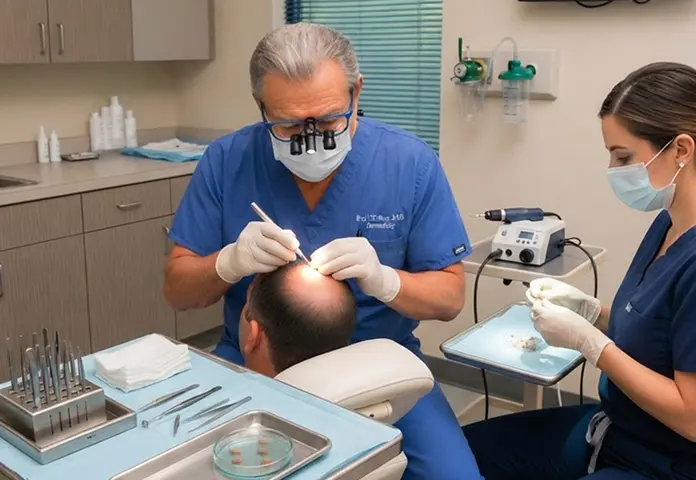
With FUE: In follicular unit extraction, follicular units are removed individually from the donor area using small, specialized instruments. The extractions are distributed strategically throughout the safe donor region to preserve a balanced appearance and avoid excessive depletion in any one location. Each extracted graft may contain one, two, three, or occasionally more hairs. The grafts are collected carefully and transferred for examination and preparation. FUE leaves many small extraction sites rather than a linear incision. These sites heal individually and are generally difficult to detect once healing is complete and the surrounding hair has grown.
With FUT: In follicular unit transplantation, a narrow strip of tissue containing healthy follicles is removed from the donor area. The donor incision is then carefully closed, leaving a fine linear scar that is normally concealed by the surrounding hair. The donor tissue is transferred to the graft-preparation team, where it is divided into naturally occurring follicular units under magnification. FUT may be advantageous for certain patients when a larger number of grafts is required, when preserving the broader donor area is especially important, or when the patient’s hair characteristics and long-term plan make strip harvesting the more appropriate option.
Step - 5
Step - 6
Step - 7
Step - 8
Step - 9
Step - 10

The Day After Your Procedure
Days 2–7
Days 7–10
Weeks 2–6
During the first few months, there may be little visible activity above the surface of the scalp. Although the transplanted follicles are present, many are still progressing through their resting phase. This can feel like a quiet part of the process, but it is not an indication that the transplant has failed. Hair growth occurs according to the biological cycle of each follicle, and the follicles do not all begin growing at the same time. Continued patience is important during this stage.
Months 1–3
Around Month 3
Months 4–6
Months 6–9
Months 9–12
Months 12–18